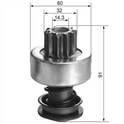
Can Bendix Drive be used in small engines?
As a long - time supplier of Bendix Drive, I've been frequently asked whether Bendix Drive can be employed in small engines. This query has sparked countless discussions within the industry, and today, I'm eager to dive deep into this topic.
Understanding the Bendix Drive
Before we address its compatibility with small engines, let's first understand what a Bendix Drive is. A Bendix Drive is a crucial component in the starting system of an engine. It serves to engage the starter motor with the engine's flywheel or ring gear. Once the engine starts and reaches a certain speed, the Bendix Drive disengages the starter motor to prevent damage.
The basic principle behind a Bendix Drive is quite simple yet ingenious. When the ignition switch is turned on, an electric current is sent to the starter motor. The Bendix Drive, which is mounted on the starter motor shaft, moves forward due to the magnetic field generated by the starter solenoid. This forward movement causes the drive gear to mesh with the engine's flywheel or ring gear. As the starter motor rotates, it transfers power to the engine, initiating the starting process. After the engine starts, the speed of the flywheel exceeds that of the starter motor, at which point the Bendix Drive automatically disengages the drive gear from the flywheel.
There are different types of Bendix Drives available in the market. Some are designed for heavy - duty applications, while others are more suitable for lighter - duty use. For more information on our range of Bendix Drives, you can check out Starter Bendix Drive and Starter Motor Bendix.
Characteristics of Small Engines
Small engines typically refer to engines with relatively low power output, usually found in applications such as lawnmowers, generators, small boats, and some garden equipment. These engines have their own unique characteristics.
Firstly, small engines are designed to be compact and lightweight. Space is a precious commodity in these applications, so components need to fit into tight spaces. Secondly, they often operate under lower torque requirements compared to large - scale industrial or automotive engines. Their power output is usually in the range of a few horsepower to a couple of dozen horsepower.
In addition, small engines may have different starting mechanisms. Some may rely on manual starting, like pull - start systems, while others are equipped with electric starting systems. For those with electric starting systems, the choice of starting components, including the Bendix Drive, becomes crucial.
Factors for Compatibility
When considering whether a Bendix Drive can be used in small engines, several key factors need to be evaluated.
Torque Requirements
As mentioned earlier, small engines have lower torque requirements. A Bendix Drive must be able to transfer sufficient torque from the starter motor to the engine to initiate the starting process. If the Bendix Drive is too large or designed for high - torque applications, it may be over - engineered for small engines. Conversely, if it cannot provide enough torque, the engine may fail to start. Our 8n Starter Bendix is designed to balance the torque requirements for a variety of small - engine applications.
Size and Space
The compact nature of small engines demands that the Bendix Drive is also small and lightweight. It should be able to fit into the engine's starting system without taking up excessive space. Modern Bendix Drives for small engines are often designed with a focus on miniaturization while maintaining their functionality. Our engineering team has been constantly working on optimizing the size and weight of our Bendix Drives to meet the space constraints of small - engine applications.
Durability and Reliability
Small engines are often used in outdoor or harsh environments, where they may be exposed to dust, moisture, and temperature variations. The Bendix Drive must be able to withstand these conditions and operate reliably over an extended period. High - quality materials and advanced manufacturing processes are used to ensure the durability of our Bendix Drives. For example, the Starter Motor Drive Bendix is built with robust materials that can resist wear and corrosion.


Advantages of Using Bendix Drive in Small Engines
If the Bendix Drive is properly selected and installed, it can bring several advantages to small engines.
Efficient Starting
A well - designed Bendix Drive ensures smooth and efficient engagement and disengagement between the starter motor and the engine. This leads to a quicker and more reliable starting process, even in cold weather or under challenging conditions. Small engine users can start their equipment promptly, which is especially important for time - sensitive tasks like mowing a lawn or powering a generator during an outage.
Cost - Effectiveness
Compared to some other starting systems, Bendix Drives can be a cost - effective solution for small engines. They are relatively simple in design and require less maintenance in the long run. This means that small engine manufacturers or users can save on both the initial purchase cost and the ongoing maintenance expenses. Our SVC PWR AWN offers excellent performance at a competitive price, making it an attractive option for small - engine applications.
Compatibility with Existing Systems
Many small engines are already designed with a starting system that can accommodate a Bendix Drive. This makes it easy to retrofit or replace an existing Bendix Drive without major modifications to the engine. This adaptability ensures that users can upgrade or repair their small engines without significant hassle or cost.
Challenges and Limitations
However, there are also some challenges and limitations when using Bendix Drives in small engines.
One of the main challenges is the potential for gear wear. In small engines, the gears of the Bendix Drive may experience more wear due to the relatively lower lubrication and the impact of frequent starting. This can lead to a decrease in performance over time and may require more frequent replacement of the Bendix Drive.
Another limitation is that in some extreme conditions, such as very low temperatures, the engagement of the Bendix Drive may be less smooth. This can result in a delay in starting or even a failed start. Engine manufacturers and users need to be aware of these limitations and take appropriate measures to mitigate them, such as using engine heaters or ensuring proper maintenance.
Conclusion
In conclusion, Bendix Drive can indeed be used in small engines, but careful consideration is required. By taking into account factors such as torque requirements, size and space, and durability, users can select the most suitable Bendix Drive for their small - engine applications. The advantages of using a Bendix Drive, including efficient starting, cost - effectiveness, and compatibility with existing systems, make it a viable option for many small - engine users.
If you are interested in exploring our range of Bendix Drives for small engines or have any questions regarding their application, please feel free to reach out to us. We are more than happy to assist you in making the right choice for your specific needs. Whether you are a small - engine manufacturer looking for reliable components or an end - user in need of a replacement Bendix Drive, we have the expertise and products to meet your requirements. Start a conversation with us today to discuss your procurement needs.