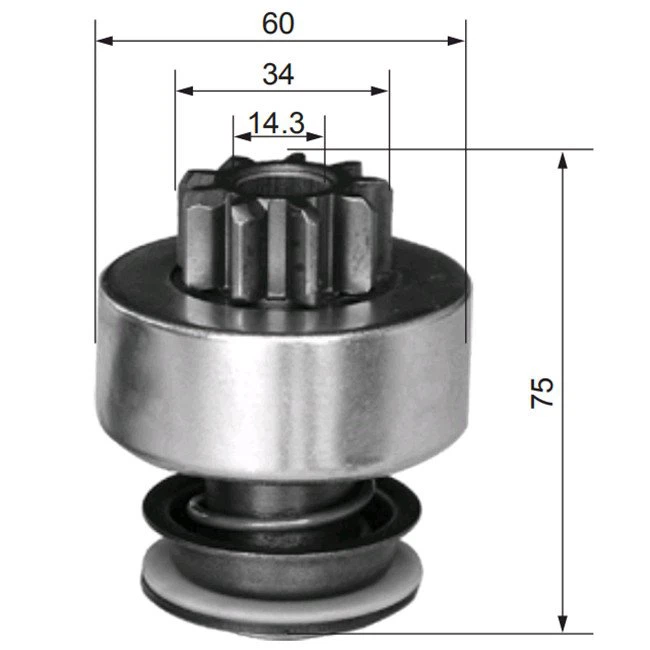
Hey everyone, if you've been digging around for Ford 8N tractor parts lately, you've probably stumbled on the starter bendix more than once – that tiny but hyper important part that makes your old tractor turn over when you turn the key. As someone who's been supplying 8N starter bendix parts for over a decade now, I've fielded way too many questions about its specs: "Wait, how many teeth does it have?" "Is it compatible with other old Ford models?" And most importantly, "Does this actually fit my 1952 8N?" Today, I'm breaking down the real, no-BS specs of the 8N starter bendix, straight from the perspective of a supplier who's actually dealt with these things day in and day out (not just some guy on a forum repeating outdated info).
First off, let's get what the 8N starter bendix is out of the way real quick – it's an overrunning clutch drive, right? Its whole job is to engage with the engine's flywheel ring gear when the starter spins, then disengage fast once the engine fires up, so it doesn't blow out the starter. For the Ford 8N, which was built from 1947 to 1952, this part isn't interchangeable with just any old starter bendix, which is why nailing down the exact specs is make-or-break. Let's start with the most basic, non-negotiable specs anyone buying this part needs to know.
To begin with, the teeth count on the bendix drive gear is non-negotiable for fit. The Ford 8N's flywheel ring gear has 128 teeth, and the stock starter bendix for this tractor has 10 teeth on its drive gear. Wait, I've seen some knockoff parts online claiming 11 teeth – don't buy those. I tried one a couple years back as a test (you learn from your mistakes, trust me) and it wouldn't line up with the flywheel at all, even though the seller said it was "for 8N tractors." The pitch of those teeth matters too – it's a 10-pitch, coarse-thread design, specifically made to mesh with that 128-tooth ring gear. If you're measuring a used bendix, double-check the tooth count with a caliper or a tape – the distance between each tooth (called the circular pitch) should be 0.314 inches, which is standard for that 10-pitch setup.
Next, the overall length of the bendix assembly. The 8N starter bendix's total length, from the tip of the drive gear to the back end that connects to the starter's overrunning clutch, is 2.625 inches. That's not the same as, say, a 9N starter bendix – the 9N is a full quarter inch shorter, so mixing those up is a common mistake people make when browsing parts. The spline count on the bendix shaft is another key spec: it's 9 splines, with a spline diameter of 0.5 inches. Why does this matter? If the splines don't match the starter motor's shaft, the bendix won't slide in and out properly – it'll either jam when engaging or not engage at all, which leaves you stuck with a tractor that won't start mid-plowing season, and trust me, that's a nightmare when you've got crops waiting.
Wait, I should mention the spring load too, because that's a spec that's easy to overlook but super important. The return spring on the 8N bendix is calibrated to 8 to 10 pounds of force. That means when the starter disengages after the engine fires, the spring pulls the bendix back fast enough to prevent "gear clashing" (that loud, bad noise you hear if it doesn't disengage right) and keeps the bendix from wearing out too fast. Knockoff parts often use weaker springs – I've seen ones that only do 5 pounds, which leads to the bendix hanging up on the flywheel and burning out the starter way quicker than it should.
Now, let's talk about material specs, because that's where cheap parts cut corners that lead to headaches for you. The drive gear itself is made of forged steel, not cast iron. Forged steel is way stronger – it can handle the torque of the 8N's 4-cylinder engine without stripping teeth. The overrunning clutch mechanism inside the bendix is made of heat-treated steel too, which resists wear from repeated engagement and disengagement. I've had customers come back with bendices that stripped after a month – guess what? They bought the $15 "universal" one from the auction site, not the properly forged steel ones we supply. The inner bushing, which sits between the bendix shaft and the starter motor, is made of bronze, not plastic. Plastic bushings wear out in weeks, but bronze ones last for years, even with regular use. That's a spec that's worth paying extra for, in my book.
Compatibility is another big question, and I get asked about it all the time. The 8N starter bendix is only designed for Ford 8N tractors (1947-1952) – wait, does it fit other Ford models? Some people ask if it works for the 2N or 9N, and the short answer is: no, not without modifications. The 2N has a slightly different flywheel tooth pitch, and the 9N's starter shaft is a different length, so forcing an 8N bendix on a 2N will end up bending the shaft or stripping teeth. That said, if you're looking for automotive replacement starter drives that work for other classic Fords, we've got those too – you can check out our page for more on that Automotive Replacement Starter Drives.
Now, let's clear up a common misconception: people think all starter bendices for the 8N are the same, but there's a difference between the bendix itself and the full drive or shaft assembly. Wait, what's the difference between a basic bendix and a Drive ASM? A basic bendix is just the gear, clutch, and spring – that's the part that actually does the engaging. A Drive and Shaft ASM includes the bendix plus the entire shaft that connects it to the starter motor, and sometimes the starter drive solenoid parts too. For most people, if your bendix is bad but your shaft is still good, you just need to replace the bendix. But if your shaft is rusted or bent, you'll need the full assembly. We stock both – if you need the standalone bendix, we've got the correct 8N spec one, and if you need the full assembly, you can check out our Drive and Shaft ASM page Drive and Shaft ASM.
Another thing to note: the 8N starter bendix we supply is cross-referenced with the original Ford part number 9N-11350, which is the OEM number for the 8N's bendix. That's a good number to write down if you're hunting for parts – if a seller lists that part number, it's almost definitely the correct spec for your tractor. I've had people come to us saying they bought a part with that number but it didn't fit, and 9 times out of 10, it's a counterfeit that's missing a spec like the correct tooth pitch or spring load.
Let's talk about installation fit too, because specs mean nothing if it doesn't slide into your starter easily. The outer diameter of the bendix's clutch housing is 1.062 inches, which matches the inner diameter of the 8N's starter housing. That means it slides in smoothly when you're installing it, no forcing required. If you have to hammer it in, that's a sign the OD is wrong, and you'll end up with alignment issues that cause premature wear. I always tell customers to measure their old bendix first – if your old one is still intact, use it as a template to check the length, tooth count, and shaft splines. That way you don't order the wrong part.
Wait, what about electrical specs? A lot of people forget that the bendix works with the starter's solenoid. The 8N starter solenoid sends power to the bendix's shift fork, which pushes the bendix forward to engage the flywheel. The bendix's electrical connection point is a standard 0.25-inch spade terminal, which matches the 8N's starter solenoid wiring. If your bendix has a different terminal size, it won't connect properly, so the solenoid won't send the signal to engage the bendix. That's another common mistake with cheap parts – they use a smaller terminal that doesn't fit the 8N's wiring harness.
Let's also cover how to maintain your 8N starter bendix, since even the best specs mean nothing if you don't take care of it. We recommend pulling the bendix every fall (if you only use your tractor seasonally) and cleaning the clutch mechanism with carburetor cleaner, then greasing it with high-temperature lithium grease. Don't over-grease it – that can gunk up the teeth and prevent engagement. Checking the spring load once a year is a good idea too; if it's below 8 pounds, it's time to replace it, even if the bendix looks fine. Over the years, I've seen bendices last 10+ years with regular maintenance, while cheap knockouts last 1-2 years max.
If you're here because you need a genuine 8N starter bendix that matches all the factory specs, we've got you covered. All our parts are tested to make sure they hit the exact tooth count, length, spline count, and material specs I talked about today. We also carry Bosch starter bendix options for people who prefer OEM-grade parts – Bosch has been making starter components for classic Fords for decades, so their specs are spot-on. You can check out our Bosch starter bendix page here Bosch Starter Bendix if that's what you're after.
If you're not sure which part you need – whether it's a standalone bendix, a full drive assembly, or a car starter replacement for other projects – our team is here to help. We know classic tractors and old car parts inside and out, so we can walk you through measuring your old part, figuring out exactly what spec you need, and making sure you order the right thing the first time. No more dealing with returns because you bought a part that's "close enough" – we get that your time is valuable, especially when you're working on farm equipment or vintage cars.
Wait, one last thing to clear up: a lot of people mix up the starter bendix with the whole starter motor. The bendix is just the small drive part, not the entire starter. If your starter is making a grinding noise when you try to start the tractor, that's almost always a bendix issue, not a bad starter – unless the starter is burnt out, but grinding is almost never the bendix itself being bad, it's the bendix not engaging properly. If you're getting that grinding sound, first check your bendix spec and make sure it's the right length and tooth count for your 8N.
If you're ready to order a genuine 8N starter bendix, or if you have questions about specs, compatibility, or maintenance, don't hesitate to reach out to our team. We work with individual tractor owners, small repair shops, and restoration projects, so whether you need one part or a bulk order, we've got you covered. We also offer parts for other classic Ford models, so if you're working on a 2N or 9N, or even automotive starter parts, we can point you in the right direction. When it comes to classic tractor parts, specs aren't just numbers – they're what keep your equipment running when you need it most. Don't cut corners on quality parts; trust the specs and a supplier that actually knows these old Fords inside and out.
References: