As a leading supplier of Drive and Shaft ASM, I've had the privilege of working closely with various industries and understanding the critical role that splines play in these assemblies. In this blog, I'll delve into the different types of splines used in Drive and Shaft ASM, their unique characteristics, and applications.
What are Splines?
Splines are a series of ridges or teeth machined onto a shaft or inside a bore, which mesh with corresponding grooves on a mating component. This design allows for the transfer of torque between the two parts while accommodating relative motion, such as sliding or rotation. Splines are commonly used in Drive and Shaft ASM to ensure a secure and reliable connection between the drive and the shaft, enabling efficient power transmission.
Types of Splines Used in Drive and Shaft ASM
Straight - Sided Splines
Straight - sided splines are one of the most basic and widely used types of splines in Drive and Shaft ASM. They have straight teeth with parallel sides, which makes them relatively easy to machine. The load is distributed along the teeth, and they are capable of transmitting high torque. Straight - sided splines are often used in applications where the shaft and the hub need to be assembled and disassembled frequently, such as in automotive transmissions and industrial machinery.
The simplicity of straight - sided splines also makes them cost - effective. However, they may require some form of keyway or other locking mechanism to prevent axial movement in certain applications.
Involute Splines
Involute splines are characterized by their curved tooth profile, which follows an involute curve. This design offers several advantages over straight - sided splines. Firstly, the involute profile provides a more uniform distribution of stress along the teeth, which increases the load - carrying capacity of the spline connection. Secondly, involute splines are more forgiving in terms of misalignment between the shaft and the hub. This is particularly important in applications where there may be some degree of angular or parallel misalignment, such as in high - speed rotating machinery.
Involute splines are commonly used in aerospace, automotive, and heavy - duty industrial applications. For example, in aircraft engines, involute splines are used to connect the drive shaft to various components, ensuring reliable power transmission under extreme conditions.
Serrated Splines
Serrated splines have a triangular tooth profile. They are designed to provide a high - strength connection with a relatively small number of teeth. Serrated splines are often used in applications where space is limited and a high torque - to - size ratio is required.
The triangular shape of the teeth allows for a self - centering effect, which helps to align the shaft and the hub accurately. This makes serrated splines suitable for applications where precision is crucial, such as in medical equipment and high - precision machinery.
Helical Splines
Helical splines have teeth that are cut at an angle to the axis of the shaft. This helical design provides a smooth and continuous transfer of torque, reducing vibration and noise during operation. Helical splines are commonly used in applications that require high - speed rotation and smooth power transmission, such as in electric motors and gearboxes.
The helical shape also allows for a larger number of teeth to be in contact at any given time, which increases the load - carrying capacity of the spline connection. However, helical splines require more precise machining and may generate axial forces, which need to be accounted for in the overall design of the Drive and Shaft ASM.
Applications of Different Spline Types in Drive and Shaft ASM
Automotive Industry
In the automotive industry, different types of splines are used in various components of the Drive and Shaft ASM. For example, straight - sided splines are often used in the transmission system to connect the gears to the shafts. This allows for easy assembly and disassembly during maintenance and repair. Involute splines are used in the drive shafts of vehicles to transmit torque from the engine to the wheels. Their ability to handle misalignment and high loads makes them ideal for this application.
Serrated splines can be found in the steering column of some vehicles, providing a high - strength connection in a compact space. Helical splines are used in the electric power steering systems, where smooth and quiet operation is essential.
Industrial Machinery
Industrial machinery relies heavily on Drive and Shaft ASM with different spline types. In heavy - duty machinery such as cranes and excavators, involute splines are used in the drive shafts to transfer large amounts of torque. Straight - sided splines are commonly used in conveyor systems, where the shafts need to be easily replaced or adjusted.
Helical splines are used in high - speed rotating machinery such as turbines and compressors, where smooth power transmission and reduced vibration are critical for efficient operation. Serrated splines are used in precision machining equipment, ensuring accurate alignment and torque transfer.
Aerospace Industry
The aerospace industry demands the highest level of reliability and performance from Drive and Shaft ASM. Involute splines are the most commonly used type of splines in aircraft engines and landing gear systems. Their ability to handle high loads and misalignment makes them suitable for the extreme conditions encountered in aerospace applications.
Helical splines are used in some aerospace components where smooth and efficient power transmission is required, such as in the control systems of aircraft. The aerospace industry also uses serrated splines in certain precision components to ensure accurate alignment and torque transfer in a limited space.
Related Products and Their Spline Applications
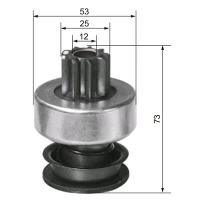
When it comes to specific products in the Drive and Shaft ASM, we can look at the Bendix for Starter Motor. The splines in the Bendix for Starter Motor are designed to provide a reliable connection between the starter motor and the engine flywheel. Straight - sided splines are often used in this application, allowing for easy engagement and disengagement of the starter drive.


The Bendix Drive also utilizes splines to transfer torque from the starter motor to the engine. The spline design ensures that the drive can engage smoothly with the flywheel teeth and transmit the necessary torque to start the engine. Depending on the application, involute or straight - sided splines may be used.
Accurate Starter Drives require precise spline connections to ensure accurate engagement and reliable operation. Serrated or involute splines are commonly used in these drives to provide a high - strength and precise connection between the starter motor and the engine components.
Why Choose Our Drive and Shaft ASM?
As a Drive and Shaft ASM supplier, we have extensive experience in manufacturing high - quality splines for various applications. Our team of engineers and technicians uses the latest manufacturing techniques and equipment to ensure the precision and reliability of our products.
We offer a wide range of spline types, including straight - sided, involute, serrated, and helical splines, to meet the diverse needs of our customers. Whether you are in the automotive, industrial, or aerospace industry, we can provide you with the right Drive and Shaft ASM solution.
Our commitment to quality is reflected in our strict quality control processes. Every product undergoes rigorous testing to ensure that it meets or exceeds industry standards. We also offer excellent customer service, providing technical support and assistance throughout the purchasing process.
Contact Us for Procurement
If you are in the market for high - quality Drive and Shaft ASM, we invite you to contact us for procurement. Our team is ready to discuss your specific requirements and provide you with a customized solution. Whether you need a small quantity for a prototype or a large - scale production order, we can accommodate your needs.
References
- "Mechanical Design Handbook", by Robert C. Juvinall and Kurt M. Marshek
- "Machine Design: An Integrated Approach", by Robert L. Norton
- Industry standards and technical documents related to Drive and Shaft ASM