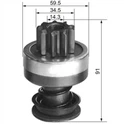
Hey there! As a supplier of overrunning - clutch drives, I often get asked about the maximum power these drives can handle. It's a crucial question for anyone looking to use these drives in their machinery or vehicles. So, let's dive into this topic and break it down.
First off, what exactly is an overrunning - clutch drive? Well, it's a mechanical device that allows the drive shaft to rotate freely in one direction while transmitting torque in the other. This feature makes it super useful in a variety of applications, like starters in cars and other engines. When the engine starts, the overrunning - clutch drive transfers power from the starter motor to the engine's flywheel. Once the engine is running, the drive disengages, preventing the engine from driving the starter motor at high speeds.
Now, back to the main question: what's the max power an overrunning - clutch drive can handle? The answer isn't straightforward because it depends on several factors.
Design and Construction
The way an overrunning - clutch drive is designed and built plays a huge role in determining its power - handling capacity. For example, the materials used in its construction are crucial. High - quality metals like hardened steel can withstand more stress and torque compared to lower - grade materials. The size and shape of the clutch components also matter. A larger clutch with a greater surface area for friction can generally handle more power. Some drives are designed with multiple clutch elements to distribute the load more evenly, which increases their power - handling ability.


Application Requirements
The specific application where the overrunning - clutch drive is used also affects its maximum power capacity. In automotive starters, the power requirements are different from those in industrial machinery. For a car starter, the drive needs to handle enough power to crank the engine over during startup. Usually, car starters require relatively short - duration, high - torque bursts of power. On the other hand, industrial applications may need continuous power transmission, which means the drive has to be able to handle a steady load over a longer period.
Let's take a closer look at some common applications and their power requirements.
Automotive Starters
In the automotive world, overrunning - clutch drives are a key part of the starter system. When you turn the key in the ignition, the starter motor engages the drive, which then meshes with the engine's flywheel. The drive has to transfer enough power to overcome the engine's compression and get it running. The power needed for this depends on the size and type of the engine. A small, four - cylinder engine will require less power compared to a large V8 engine.
For instance, a typical compact car with a four - cylinder engine might need a starter with an overrunning - clutch drive that can handle around 1 - 2 horsepower (hp) during startup. However, a high - performance sports car or a large SUV with a V8 engine could require a drive capable of handling 3 - 5 hp or more.
If you're looking into the details of automotive overrunning - clutch drives, you might want to check out the Bendix System. It's a well - known system used in many cars and has specific power - handling characteristics based on its design.
Industrial Machinery
In industrial settings, overrunning - clutch drives are used in various types of machinery, such as conveyor systems, pumps, and generators. These applications often require continuous power transmission. The power capacity of the drive needed depends on the size and speed of the machinery.
For a small conveyor system in a factory, an overrunning - clutch drive might need to handle a few horsepower. But for a large industrial pump or generator, the drive could be required to handle tens or even hundreds of horsepower. The design of the drive in these applications has to be more robust to handle the continuous load. The Prestolite Starter Bendix is an example of a drive that can be used in some industrial applications, and it's engineered to meet specific power requirements.
Heat Dissipation
Another important factor that affects the maximum power an overrunning - clutch drive can handle is heat dissipation. When the drive is transmitting power, friction is generated, which produces heat. If the heat isn't dissipated properly, the temperature of the drive can rise to a point where it damages the clutch components.
To ensure proper heat dissipation, some drives are designed with cooling fins or other heat - transfer mechanisms. The environment in which the drive operates also plays a role. A drive used in a well - ventilated area will be able to dissipate heat more effectively compared to one used in a confined space.
Wear and Tear
Over time, wear and tear can reduce the power - handling capacity of an overrunning - clutch drive. The friction surfaces of the clutch can wear down, and the internal components can become damaged. Regular maintenance and inspection are essential to keep the drive in good working condition.
If you notice any signs of wear, such as slipping or unusual noises, it might be time to consider replacing the drive. You can find more information about car starter replacement if you're dealing with automotive applications, or look into the Starter Bendix Drive for general starter - related issues.
Tooth Configuration
The tooth configuration of the overrunning - clutch drive also impacts its power - handling ability. For example, the 11 Tooth Starter Bendix has a specific tooth design that affects how it meshes with the flywheel or other driven components. A more robust tooth design can handle more torque and power without stripping or breaking.
In conclusion, there isn't a one - size - fits - all answer to the question of the maximum power an overrunning - clutch drive can handle. It depends on design, application, heat dissipation, wear and tear, and tooth configuration. As a supplier, we have a range of overrunning - clutch drives to meet different power requirements. Whether you're in the automotive industry or an industrial setting, we can help you find the right drive for your needs.
If you're interested in purchasing overrunning - clutch drives or have any questions about their power - handling capacity, feel free to reach out. We're here to assist you in making the best choice for your application.