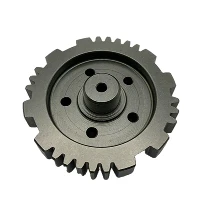
If you're someone who works in auto components, you've definitely heard the name Bendix Drive tossed around in conversations about starter systems. But when it comes to hybrid vehicles, its role isn't as straightforward as it is in gas-only cars-especially since hybrids balance a gas engine, an electric motor, and a high-voltage battery to keep things efficient. As a supplier who's been making and refining these components for years, I've gotten a ton of questions from hybrid manufacturers: Why does a part designed for old-school starters matter here? Let's break this down, how it works in hybrids, and why it's non-negotiable for smooth, reliable performance.
First, let's recap what a Bendix Drive actually does, in simple terms. If you've ever tried to turn on a car, you know the starter has to spin the engine's flywheel to get it going. The Bendix Drive is the tiny but critical piece that connects the starter motor to that flywheel when you start the car, then disconnects right after the engine fires up. If it didn't disengage, the flywheel's fast spin would destroy the starter motor in seconds. In gas cars, this is pretty standard-one start, one engagement, one disengagement. But hybrids? They start and stop way more often. Like, way more.
Think about it: A hybrid's whole trick is shutting off the gas engine when you're coasting, stopped at a light, or going slow. Then, the electric motor kicks in to move the car, and when you need more power (like accelerating onto a highway), the gas engine fires back up. That means the starter system (and yes, its Bendix Drive) might have to engage 5, 10, even 20 times in a single trip-compared to once or twice a day in a regular gas car. Suddenly, a component that's minor in a gas car becomes a workhorse in a hybrid. That's where the heavy lifting for our team comes in-designing a Bendix Drive that can handle repeated engagements without wearing out, no matter how fast the flywheel is spinning when it needs to connect.
Now, let's get into the specific role in hybrids, because it's not just "start the engine." There are two main hybrid types, and the Bendix Drive's job shifts a little for each. In mild hybrids (the ones with a small electric motor that only assists the gas engine, not runs the car on its own), the start-stop cycles are frequent but the engine's startup isn't super fast-so the Bendix is working under lower torque loads most of the time. But in full hybrids (those that can drive on electric power alone), the gas engine has to kick in faster, and the flywheel might already be spinning a little from the electric motor's inertia. That means the Bendix has to engage smoothly, without clunking or grinding, even when two parts are already moving at different speeds. A bad Bendix here would make the startup feel jerky, or even damage the flywheel's teeth over time.
I've seen a lot of manufacturers try to cut corners here, opting for standard Bendix Drives from gas car applications. That's a mistake. Hybrids need a drive that's built for "overrunning"-that's the tech term for when one part is spinning faster than the other, like when the engine's already running faster than the starter motor could spin. The Bendix's overrunning clutch (yep, that's the Starter Bendix Drive Clutch we specialize in) is what makes this possible. Without it, when the engine fires up and starts spinning on its own, it would spin the starter motor backward, blowing out the motor's windings. That's a catastrophic failure, and we've had more than one client come to us after that happened because they used a generic part.


Let's talk about our own line of Bendix Drives, too-since we've been at this, we've optimized for hybrid demands. For example, our Bosch Starter Bendix is designed to handle the higher cycle counts hybrids require. It uses a precision-machined overrunning clutch that engages and disengages in milliseconds, no slip or play. We also make specific variants, like the 8n Starter Bendix, which is tailored for compact full hybrids where space is tight-engine bays in these cars are super crowded, so we've slimmed down the drive without losing durability. And if you're working on a self-start hybrid that relies on the electric motor to fire the engine without a key fob click? Our Self Starter Bendix is built for rapid, no-fuss engagements every single time.
Wait, there's another piece of the puzzle I don't see enough people mention: the Drive and Shaft ASM. That's the assembly that connects the Bendix Drive to the electric motor, right? In hybrids, the electric motor isn't just a helper-it's often the link between the battery and the engine. So if the Drive and Shaft ASM is misaligned or worn, the Bendix can't engage properly, even if the clutch is perfect. We design that assembly to work seamlessly with our Bendix Drives, so there's no slop or vibration during startup. We test every single unit in our lab to 100,000 start cycles-way more than the average hybrid will ever see in its lifetime-just to make sure it doesn't fail.
A common myth I hear: "The electric motor in a hybrid replaces the starter, so the Bendix Drive is obsolete." No way. Let's clarify that. The electric motor handles low-speed electric driving, but when you need high torque (like merging onto a highway, or climbing a hill), the gas engine still has to kick in, and that needs a dedicated starter system with a Bendix Drive. The electric motor can't handle the sustained torque needed to spin the gas engine's heavy components quickly enough, and it's not built for those repeated high-load engagements. So the Bendix is still the unsung hero here-it's the go-between that makes that transition from electric to gas smooth.
Let's use an example: A Toyota Prius (one of the most common full hybrids) starts its gas engine 15-20 times on a typical 30-minute commute. Each time, the Bendix Drive has to extend its pinion gear, lock into the flywheel teeth, spin the engine to its idle speed, then retract and disengage before the engine hits 1,000 RPM. If the Bendix sticks, the starter motor keeps spinning against the flywheel, creating friction that wears down both parts. If it engages too hard, it chips the flywheel teeth, leading to a $1,000+ repair. We've had clients come to us after field failures like that-they went with a cheaper, off-the-shelf Bendix, and it cost them more in warranty claims than if they'd used our purpose-built hybrid parts.
Another thing to consider: durability in extreme conditions. Hybrids are used in everything from desert heat to cold northern winters. The Bendix Drive has to perform when the engine oil is thick in the cold, or when the starter is working extra hard to turn over an engine that's been sitting in 100°F heat. Our drives use high-grade steel for the pinion gear and clutch components, so they don't warp or seize up when temperatures swing. We also coat the moving parts to resist corrosion-something generic Bendixes often skip, leading to premature wear in harsh climates.
Now, I know a lot of auto engineers are focused on high-voltage batteries and advanced electronics when building hybrids, but the Bendix Drive is a mechanical part that still makes or breaks the driver's experience. No one notices a smooth startup-they only notice when it's clunky, or when the car won't start at all. That's why our team prioritizes reliability over cost, even when clients push for lower prices. We don't cut corners on material quality, because we know that a faulty Bendix can ruin a hybrid's reputation for smooth, efficient performance.
If you're a hybrid manufacturer sourcing starter components, or a repair shop looking to replace worn parts, you need a Bendix Drive that's designed specifically for hybrid use. Our range includes variants for every hybrid type: the Bosch Starter Bendix for mild hybrids, the 8n Starter Bendix for compact full hybrids, the Self Starter Bendix for models with keyless start systems, and the Drive and Shaft ASM to pair with them all. We've tested these parts in real-world hybrid fleets, not just lab conditions, so we know they hold up.
At the end of the day, the Bendix Drive's role in hybrids is way more than just "starting the engine." It's about enabling seamless transitions between electric and gas power, handling repeated engagements without wear, and protecting both the starter motor and the engine's flywheel from damage. It's a small part, but it's critical to the whole hybrid system working as intended.
If you're looking for a Bendix Drive supplier that understands the unique demands of hybrid vehicles, we're here to help. Whether you need a custom variant for a new model or replacement parts for existing fleets, our team has the expertise and products to meet your needs. Reach out to us to talk through your requirements, and we'll work with you to find the right solution.