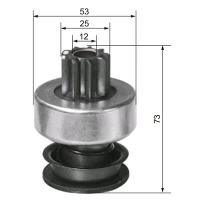
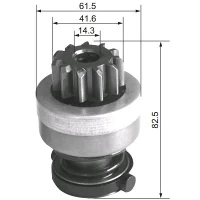
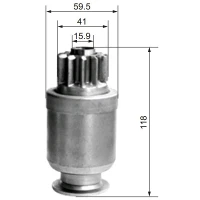
A Bendix drive is a clever mechanical clutch mechanism that allows a starter motor to engage and disengage from an engine's flywheel automatically, without requiring manual intervention or complex linkages. Invented by Vincent Bendix in 1910, this device solved the critical problem of how to mesh a small, high-speed electric motor with a large, stationary engine without grinding gears or damaging the starter.
The mechanism consists of four key components: a pinion gear mounted on a helically splined shaft, a heavy-duty return spring, a drive clutch, and the starter motor armature shaft. The pinion is not fixed rigidly to the shaft; instead, it rides on spiral grooves machined into the drive shaft, similar to the threads on a screw but with a much steeper pitch.
When the driver turns the ignition key, electricity flows to the starter motor, causing the armature to spin at approximately 2,000–3,000 RPM. Initially, the pinion gear remains stationary due to its inertia and the resistance of the engine it must turn. However, because the shaft beneath it is rotating rapidly within those helical splines, the pinion is forced to travel forward along the shaft-much like a nut traveling along a rotating bolt. This linear motion pushes the pinion forward until its teeth mesh with the ring gear on the engine's flywheel.
Once the pinion fully engages with the flywheel, it reaches the end of its travel and hits a stop. At this point, the pinion can no longer move forward, so the rotational force of the starter motor is transferred through the helical splines to the pinion, then to the flywheel, cranking the engine. The steep angle of the splines ensures that the torque transmission is efficient while maintaining the engagement.
When the engine fires and begins running under its own power, the flywheel immediately spins faster than the starter motor-typically 1,000 RPM or more versus the starter's 2,000 RPM. This speed differential creates a reverse force on the pinion. The faster rotation of the flywheel now drives the pinion, and due to the helical spline design, this reverse rotation forces the pinion to back away from the flywheel, disengaging the gears. Simultaneously, the return spring assists in retracting the pinion to its resting position at the rear of the shaft.
This automatic disengagement is crucial for preventing catastrophic damage. Without the Bendix mechanism, the starter motor would be driven at excessive speeds by the running engine, potentially causing the armature to explode due to centrifugal forces. The one-way clutch action ensures that power can only flow from the starter to the engine, never in reverse.
Modern variations include the overrunning clutch drive (solenoid-engaged) and permanent magnet gear reduction starters, but many small engines and classic vehicles still utilize the original inertia-driven Bendix design due to its simplicity, reliability, and lack of complex electrical solenoids. The system requires no timing adjustments or electronic controls-just pure mechanical physics utilizing inertia and spiral geometry to accomplish seamless engagement and disengagement in milliseconds.