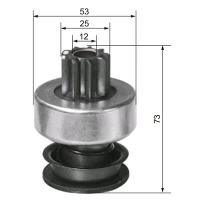
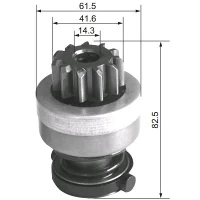
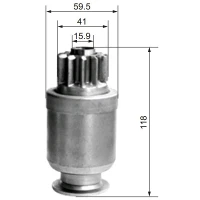
For anyone involved in automotive repair, engine parts sourcing, or starter system maintenance, the terms Overrunning-Clutch Drive and Bendix Drive often appear together. Many buyers even assume they are the same thing. While both belong to the category of starter drive mechanisms, they operate differently and offer different levels of performance, durability, and reliability.
Understanding the difference between these two systems helps engineers, mechanics, and procurement teams choose the right starter motor parts for various applications, from passenger vehicles to heavy machinery.
What Is an Overrunning-Clutch Drive?
An Overrunning-Clutch Drive, sometimes called a one-way clutch or overrunning clutch unit, is a modern design used in most current starter motors. Its internal structure generally includes rollers or sprags, which lock in one direction and freewheel in the opposite direction. This allows torque transmission during engine cranking but prevents reverse force when the engine fires up.
It provides:
- Stronger torque transfer
- Higher durability
- Better protection for the starter motor
- Stable performance in diesel engines and heavy equipment
Today, overrunning-clutch drive assemblies are the standard in most cars, trucks, motorcycles, and industrial engines.
What Is a Bendix Drive?
A Bendix Drive, also known as a Bendix starter, is an older starter engagement mechanism. It uses a helical shaft design where the starter pinion gear moves forward automatically through inertia when the motor spins. While simple and cost-effective, the Bendix drive relies heavily on rotational speed and mechanical inertia.
Its characteristics include:
- Lower cost
- Fewer internal components
- Automatic engagement using inertia
- Suitable for small engines or older vehicle models
However, Bendix systems wear out faster and are more sensitive to dirt, lubrication problems, and engine backlash.
Key Differences Between Overrunning-Clutch Drive and Bendix Drive
1. Engagement Method
Overrunning-Clutch Drive: Uses a solenoid + one-way clutch mechanism.
Bendix Drive: Depends on inertia to push the pinion gear into the flywheel.
2. Durability
Overrunning-Clutch Drive: More durable, handles higher torque, suitable for diesel and heavy-duty engines.
Bendix Drive: Faster wear and more susceptible to jamming.
3. Safety and Gear Protection
Overrunning-Clutch Drive: Automatically freewheels to protect the starter when the engine starts.
Bendix Drive: Less effective protection; reverse shock can damage gears.
4. Applications
Overrunning-Clutch Drive: Widely used in modern vehicles, trucks, agricultural machinery, and industrial equipment.
Bendix Drive: Mostly found in old-generation cars, motorcycles, scooters, and small gasoline engines.
5. Reliability
Overrunning-Clutch Drive: Highly reliable under high load and frequent starting conditions.
Bendix Drive: More suitable for simple engines with low starting torque requirements.
Which One Should You Choose?
If your goal is long-term reliability, smoother starting, and protection for the starter motor, the Overrunning-Clutch Drive is the better choice. It offers better engagement, improved mechanical strength, and longer service life. Bendix drives are more cost-effective but mainly for lightweight applications or older designs.
For buyers searching for starter drive assemblies, Bendix gear replacements, starter clutch units, or custom cold-extruded starter components, understanding these differences helps ensure compatibility and performance.
If you need reliable Overrunning-Clutch Drives, Bendix Drive assemblies, or customized precision cold-extrusion starter parts, feel free to contact Wuxi Superhuman Gear Cold Extrusion Co., Ltd. We are fully equipped to support your sourcing needs with stable quality and professional technical service.