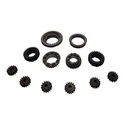
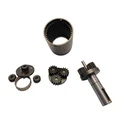
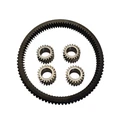
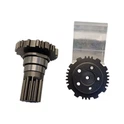
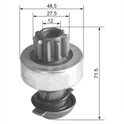
At Wuxi Superhuman Gear Cold Extrusion Co., Ltd., we've manufactured thousands of pinion gears and drive components for automotive starter systems. And the question we hear most often isn't "What is a Bendix drive?" but "Why does this small mechanism matter so much when an engine won't start?" The answer lives in real-world function-not just textbook diagrams.
Last winter, a client developing a diesel starter motor came to us with intermittent engagement issues. Their prototype worked in the lab, but field tests showed the pinion gear sometimes failed to fully mesh with the flywheel. After reviewing the Bendix drive assembly, we identified two subtle factors: the helical spline tolerance on the pinion shaft was slightly tight, and the return spring rate didn't account for low-temperature viscosity changes in the lubricant. After adjusting the cold-extruded gear geometry and validating spring performance at -30°C, engagement reliability improved to 99.8% in cold-crank testing. The fix wasn't about bigger parts-it was about precision where it counts.
The Core Function: Safe, Reliable Engine Engagement
A Bendix drive (also called an inertia drive or overrunning clutch mechanism) serves one critical purpose: it allows the starter motor's pinion gear to engage the engine's flywheel ring gear only when needed-and disengage instantly once the engine starts.
Here's how it works in practice:
- When you turn the key, the starter motor spins, and inertia (or a solenoid in modern designs) pushes the pinion gear forward along a helical shaft.
- The pinion meshes with the flywheel, cranking the engine.
- Once the engine fires and spins faster than the starter, the overrunning clutch prevents the engine from back-driving the starter motor-protecting it from catastrophic damage.
Why Manufacturing Precision Matters
From our cold extrusion experience at Superhuman Gear, three details consistently determine Bendix drive reliability:
1. Pinion gear tooth profile: Cold-extruded teeth offer superior grain flow and surface hardness compared to cut gears. This reduces wear during repeated engagement cycles-critical for start-stop vehicles.
2. Spline consistency: The helical splines that guide pinion movement must balance smooth travel with positive engagement. We control this through precision die design and in-process monitoring.
3. Material selection: Starter components face impact loads and temperature swings. We work with clients to select alloy steels that maintain toughness after cold forming and heat treatment.
Our Practical Approach at Superhuman Gear
We don't just supply parts-we help solve engagement challenges. When a client shares a starter system issue, we start by understanding their operating conditions: cranking torque, temperature range, and duty cycle. Then we:
- Analyze pinion and spline geometry for optimal engagement dynamics
- Validate cold extrusion parameters to ensure consistent mechanical properties
- Test prototypes under simulated cranking loads and thermal cycling
- Optimize heat treatment and surface finishing for durability
The Bottom Line
The Bendix drive isn't a glamorous component-but when it works perfectly, you never notice it. When it fails, the engine won't start. At Wuxi Superhuman Gear Cold Extrusion Co., Ltd., we engineer starter drive components based on measured performance data and field-proven reliability. Because in automotive manufacturing, the best parts aren't the loudest-they're the ones that work silently, shift after shift, mile after mile.