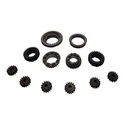
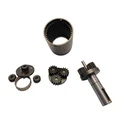
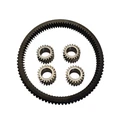
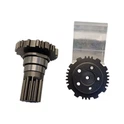
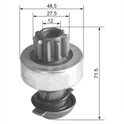
Drive and Shaft ASM is a mechanical device involving drive and shaft components.
1. The drive part is the power core of the entire device. It can be powered by a motor, which converts electrical energy into mechanical energy through the principle of electromagnetic induction. For example, in a conveyor belt system on an industrial production line, the motor drive can accurately control the speed and direction of movement of the conveyor belt. It can also be powered by an internal combustion engine, such as in some vehicles or large agricultural machinery, where the internal combustion engine burns fuel to generate power to drive the rotation of the shaft. There are also some new drive methods, such as hydraulic drive. Hydraulic drive uses liquid pressure to transmit power, has the characteristics of high power and precise control, and is often used in heavy machinery and some equipment that requires high torque output.
2. The drive part includes various transmission components, such as gears, belts and chains. Gear transmission can achieve precise speed ratio and torque transmission, and is widely used in automotive transmissions. Belt drive is relatively quiet and stable, and is often used in some equipment with high noise requirements, such as washing machines in household appliances. Chain drive has a high load-bearing capacity and plays an important role in the transmission system of motorcycles. Through these transmission components, the drive part transmits power to the shaft, so that the shaft can rotate according to certain speed and torque requirements.
3. The shaft is a rotating component, usually cylindrical. Its material selection depends on the requirements of the application scenario. For shafts that bear high torque and heavy loads, high-strength alloy steel, such as 40CrNiMoA, is generally used. This material has high strength and toughness. In some occasions with strict weight requirements, such as shafts in aerospace equipment, light alloys such as aluminum alloys may be used. The surface of the shaft usually needs to be processed, such as grinding, chrome plating, etc., to improve its surface finish and wear resistance. The shaft is mainly used to transmit torque and support rotating parts. In the mechanical system, it connects various different parts, such as gears, pulleys, etc. For example, in the spindle system of a machine tool, the rotation accuracy of the shaft directly affects the accuracy of the machined parts. The shaft can also be used as a power output component to transmit the power transmitted by the drive part to other parts that need power, so as to realize the coordinated work of the entire mechanical system.
4. ASM stands for assembly, Drive and Shaft ASM emphasizes that the drive and shaft are considered as a complete assembly. The design of this component needs to take into account the matching of the drive part and the shaft part. For example, the output torque and speed of the drive part must match the torque and speed range that the shaft can withstand to ensure that the entire component can operate stably and efficiently. In the transmission system of a car, the Drive and Shaft ASM is a very critical part. It transmits the power of the engine to the wheels, allowing the car to move. In industrial machinery, such as printing machines and textile machines, this component can ensure the normal operation of the machine and realize functions such as printing paper and spinning yarn. In the robot joints of automated production lines, the Drive and Shaft ASM can accurately control the robot's movements and improve production efficiency and product quality.
If you need a High-Quality Drive and Shaft ASM, Please contact www.wuxisuperhuman.com for further questions.