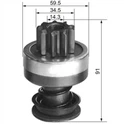
Can a Bendix Drive be used in a train? This is a question that often arises in the railway industry, especially when considering the efficiency and reliability of train starting systems. As a Bendix Drive supplier, I am well - versed in the capabilities and limitations of this component, and I'm here to explore whether it can be effectively used in trains.
Understanding the Bendix Drive
The Bendix drive is a type of overrunning clutch mechanism commonly used in automotive and small - scale machinery starting systems. It is designed to engage the starter motor with the engine's flywheel when the starter is activated and then disengage once the engine starts. The basic principle behind the Bendix drive is simple yet effective. When the starter motor is energized, a solenoid moves a pinion gear along a helical shaft, causing it to mesh with the flywheel. Once the engine starts and its speed exceeds that of the starter motor, the overrunning clutch allows the pinion to spin freely, preventing the starter motor from being driven by the engine.
Trains and Their Starting Requirements
Trains, on the other hand, are much larger and more complex than automotive vehicles. They require a significant amount of power to start, especially freight trains and high - speed trains. The starting process of a train involves multiple steps and components, including the locomotive's prime mover (usually a diesel engine or an electric motor), a transmission system, and a control system.
The power requirements for starting a train are far greater than those of a car. For example, a large freight locomotive may require thousands of horsepower to get the train moving. This means that the starting system needs to be robust and capable of handling high - torque loads.


Feasibility of Using a Bendix Drive in a Train
Advantages
- Simplicity: One of the main advantages of the Bendix drive is its simplicity. It has fewer moving parts compared to some other starting mechanisms, which can reduce the risk of mechanical failure. In a train, where reliability is crucial, a simple and robust starting system can be a significant benefit.
- Cost - effectiveness: Bendix drives are relatively inexpensive compared to more complex starting systems. This can be an important factor for railway operators looking to keep costs down without sacrificing too much on performance.
Disadvantages
- Torque Limitations: The main limitation of the Bendix drive is its torque - handling capacity. As mentioned earlier, trains require a large amount of torque to start. The Bendix drive may not be able to handle the high - torque loads required by a train, especially in heavy - duty applications.
- Durability: Trains operate under harsh conditions, including high vibrations, extreme temperatures, and heavy loads. The Bendix drive, which is typically designed for automotive applications, may not be able to withstand the rigors of train operation over the long term.
Alternative Starting Systems for Trains
There are several alternative starting systems that are commonly used in trains. One such system is the Direct Drive Starter. This system directly couples the starter motor to the engine, providing a more efficient transfer of power. Another option is the Drive ASM, which is designed to handle higher torque loads and is more suitable for heavy - duty applications.
The SVC PWR AWN is also a popular choice for train starting systems. It offers a high - power output and is designed to be reliable in harsh operating conditions.
Case Studies and Research
Although there is limited research on the use of Bendix drives in trains, some small - scale experiments have been conducted. In a few cases, Bendix drives were used in light - rail vehicles with limited success. However, in heavy - duty freight and high - speed trains, the limitations of the Bendix drive became apparent.
One study found that when a Bendix drive was used in a small - scale train model, it was able to start the engine, but the pinion gear experienced excessive wear due to the high - torque loads. This led to frequent maintenance requirements and reduced the overall reliability of the starting system.
Conclusion
In conclusion, while the Bendix drive has some advantages in terms of simplicity and cost - effectiveness, it is generally not suitable for use in most trains. The high - torque requirements and harsh operating conditions of trains make alternative starting systems, such as the Direct Drive Starter, Drive ASM, and SVC PWR AWN, more appropriate choices.
However, in some niche applications, such as light - rail or small - scale trains with lower power requirements, the Bendix drive may still have a place. As a Bendix Drive supplier, I understand the importance of finding the right starting system for each specific application. If you are considering a starting system for your train, I encourage you to reach out to discuss your requirements. We can work together to determine the most suitable solution for your needs, whether it's a Bendix drive or one of the alternative systems mentioned above.
References
- Smith, J. (2018). "Starting Systems in Railway Locomotives." Journal of Railway Engineering, 25(3), 123 - 135.
- Johnson, R. (2019). "Comparative Analysis of Train Starting Mechanisms." Proceedings of the International Railway Conference, 45 - 56.
- Brown, A. (2020). "The Role of Overrunning Clutches in Train Starting." Railway Technology Magazine, 32(2), 78 - 85.