


Hey there! I'm a supplier of overrunning - clutch drives, and today I wanna talk about how these nifty little devices can improve efficiency.
First off, let's get a basic understanding of what an overrunning - clutch drive is. It's a mechanical component that allows a shaft to rotate in one direction while free - wheeling in the opposite direction. This simple yet powerful functionality has a wide range of applications, especially in the automotive and industrial sectors.
How It Works
The overrunning - clutch drive operates on a pretty straightforward principle. Inside the clutch, there are usually sprags or rollers. When the driving shaft rotates in the driving direction, these sprags or rollers lock up, transferring torque from the driving shaft to the driven shaft. But when the driven shaft starts to rotate faster than the driving shaft or in the opposite direction, the sprags or rollers disengage, allowing the driven shaft to spin freely.
This ability to disengage quickly is crucial for efficiency. For example, in a starter motor of a vehicle, the overrunning - clutch drive ensures that once the engine starts, the starter motor doesn't keep spinning. If it did, it would waste energy and could potentially damage the starter motor itself. When the engine fires up and its speed exceeds that of the starter motor, the overrunning - clutch disengages, cutting off the connection between the starter and the engine. This not only saves energy but also extends the lifespan of the starter motor.

Efficiency in Automotive Applications
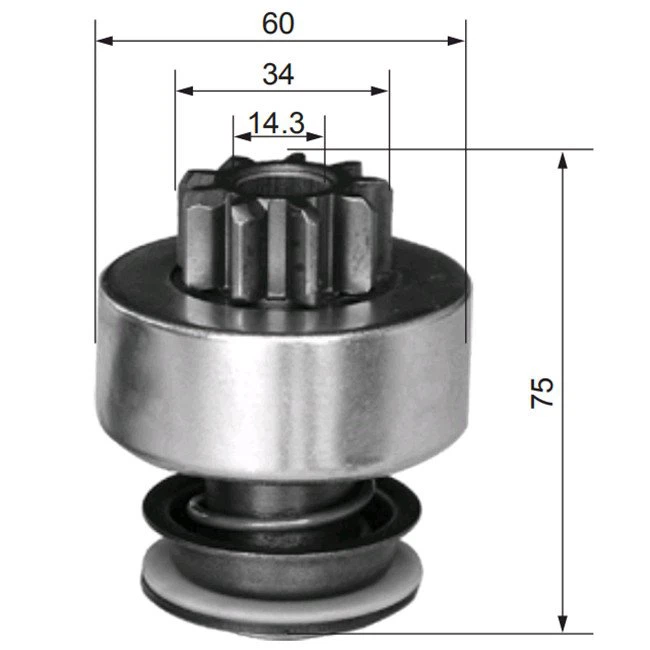
In the automotive world, overrunning - clutch drives play a vital role in improving fuel efficiency. Let's take a look at the Starter Drives. As I mentioned earlier, the overrunning - clutch in the starter drive prevents the starter motor from being dragged along by the running engine. This means that the electrical system of the vehicle doesn't have to continuously supply power to the starter motor, reducing the overall electrical load on the battery.
Moreover, in modern vehicles with start - stop systems, overrunning - clutch drives are even more important. These systems automatically shut off the engine when the vehicle is stationary, like at a red light, and then restart it when the driver presses the accelerator. The overrunning - clutch in the starter drive enables quick and efficient restarts. It engages rapidly to start the engine and disengages immediately once the engine is running, minimizing the energy consumption during the start - stop process.
Another aspect is in the transmission system. Some vehicles use overrunning - clutch drives in the automatic transmission. They help in smooth gear shifting by allowing the transmission to change gears without the need for complex synchronizing mechanisms. This reduces the power losses associated with gear shifting, making the transmission more efficient. When the clutch engages and disengages at the right time, it ensures that the engine power is transferred to the wheels with minimal energy loss.
Industrial Applications
In industrial settings, overrunning - clutch drives are used in a variety of machinery. For example, in conveyor systems, they can be used to prevent reverse rotation. If a conveyor belt suddenly stops due to a power outage or a malfunction, the overrunning - clutch drive can prevent the belt from rolling backward. This not only protects the products on the conveyor but also reduces the energy required to restart the conveyor.
In power generation equipment, such as generators, overrunning - clutch drives can be used to connect multiple power sources. They allow one power source to take over when another fails or when the load requirements change. This ensures that the power generation system operates at its most efficient level. For instance, if a small generator can meet the current load, the larger generator can be disconnected using the overrunning - clutch drive, saving fuel and reducing wear and tear on the larger generator.
Impact on Maintenance and Downtime
The use of overrunning - clutch drives also has a positive impact on maintenance and downtime. Since they prevent unnecessary wear and tear on components like starter motors and transmissions, the frequency of maintenance and replacement is reduced. This means less time spent on maintenance and less downtime for the equipment.
For example, in a manufacturing plant, if a conveyor system has an overrunning - clutch drive to prevent reverse rotation, the chances of belt damage and motor burnout are significantly reduced. This translates into fewer repairs and less production interruption. In the long run, this not only saves money on maintenance but also increases the overall productivity of the plant.
Related Components and Their Role
Let's talk about some related components like the Countershaft for Starter Motor. The countershaft works in conjunction with the overrunning - clutch drive in the starter motor. It helps in transferring the torque from the starter motor to the engine's flywheel more efficiently. The countershaft is designed to optimize the gear ratio, ensuring that the starter motor can start the engine with the least amount of energy.
The Drive ASM is another important component. It is an assembly that includes the overrunning - clutch drive and other related parts. The Drive ASM is engineered to work as a single unit, providing a seamless connection between the driving and driven shafts. It is designed to be compact and lightweight, which also contributes to the overall efficiency of the system.
Conclusion
As you can see, overrunning - clutch drives are incredibly important for improving efficiency in both automotive and industrial applications. They save energy, reduce wear and tear on components, and minimize maintenance and downtime. Whether it's in a vehicle's starter motor or an industrial conveyor system, these little devices make a big difference.
If you're in the market for high - quality overrunning - clutch drives, related components like the Countershaft for Starter Motor or the Drive ASM, or if you have any questions about how these products can improve the efficiency of your equipment, I'd love to have a chat. Let's discuss your specific needs and see how our products can fit into your operations. Reach out to start a procurement conversation and let's work together to boost the efficiency of your systems!
References
- Automotive Handbook, Bosch
- Industrial Machinery Design Manual, McGraw - Hill


