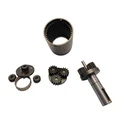
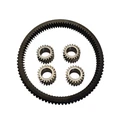
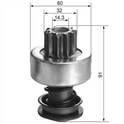
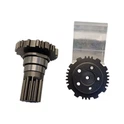
Hey there! As a supplier of overrunning - clutch drives, I'm super excited to take you through how these nifty little devices work. You might be wondering, what on earth is an overrunning - clutch drive? Well, it's a crucial component in many mechanical systems, especially in automotive starters.
Let's start with the basics. An overrunning - clutch drive is a type of clutch that allows the transmission of torque in one direction only. Think of it like a one - way street for power. It's designed to engage and transfer power when the driving shaft rotates in a specific direction, but when the driven shaft starts to spin faster than the driving shaft, it disengages. This prevents the driven shaft from driving the driving shaft, which can cause all sorts of problems in a mechanical system.
So, how does it actually work? There are a few different types of overrunning - clutch drives, but the most common ones use either sprags or rollers.
Sprag - type Overrunning - Clutch Drives
Sprags are small, wedge - shaped pieces. In a sprag - type overrunning - clutch drive, these sprags are placed between an inner and an outer race. When the driving shaft (connected to the inner race) starts to rotate in the driving direction, the sprags are forced into a wedged position between the inner and outer races. This wedging action locks the two races together, allowing torque to be transferred from the driving shaft to the driven shaft (connected to the outer race).
For example, in an automotive starter, the starter motor rotates the inner race of the overrunning - clutch drive. As the inner race spins, the sprags wedge themselves in place, and the outer race (which is connected to the flywheel of the engine) starts to turn. This cranks the engine and gets it started.
Once the engine starts running on its own, the flywheel (and thus the outer race) starts to spin faster than the starter motor (and the inner race). When this happens, the sprags are pushed out of the wedged position. They no longer lock the inner and outer races together, and the clutch disengages. This protects the starter motor from being driven by the high - speed rotation of the engine, which could damage the motor.


Roller - type Overrunning - Clutch Drives
Roller - type overrunning - clutch drives work in a similar way, but instead of sprags, they use rollers. These rollers are placed in pockets between the inner and outer races. Each pocket has a ramp - shaped surface.
When the driving shaft rotates in the driving direction, the rollers are pushed up the ramps. As they move up the ramps, they get wedged between the inner and outer races, locking them together and allowing torque transfer. Just like in the sprag - type clutch, when the driven shaft starts to spin faster than the driving shaft, the rollers are pushed back down the ramps. This releases the lock between the inner and outer races, and the clutch disengages.
Now, let's talk about why overrunning - clutch drives are so important in automotive applications. In a car, the starter motor needs to crank the engine to get it started. But once the engine is running, the starter motor can't keep trying to turn the engine. That's where the overrunning - clutch drive comes in. It ensures that the starter motor only engages when it's needed to start the engine and disengages as soon as the engine starts running on its own.
If you're in the market for an overrunning - clutch drive for your automotive needs, we've got you covered. We offer a wide range of Automotive Replacement Starter Drives that are designed to fit various makes and models of vehicles. Our products are built to last, with high - quality materials and precision engineering.
Another type of starter drive that you might come across is the Starter Bendix Drive. The Bendix drive is a type of overrunning - clutch drive that uses a different mechanism to engage and disengage. It has a helix - shaped shaft that moves the pinion gear into and out of mesh with the flywheel. When the starter motor is activated, the helix causes the pinion gear to move forward and engage with the flywheel. Once the engine starts, the pinion gear is forced back by the rotation of the flywheel, disengaging it from the flywheel.
The Bendix Drive has been around for a long time and is still widely used in many automotive applications. It's a reliable and cost - effective solution for starting engines.
We understand that choosing the right overrunning - clutch drive can be a bit confusing. That's why our team of experts is always here to help. Whether you need advice on which drive is best for your specific application or you have questions about installation and maintenance, we're just a call or an email away.
If you're a mechanic, a car enthusiast, or a business looking to stock up on overrunning - clutch drives, we can offer you competitive prices and excellent customer service. We believe in building long - term relationships with our customers, and we'll do everything we can to make sure you're satisfied with your purchase.
So, if you're interested in learning more about our overrunning - clutch drives or if you're ready to place an order, don't hesitate to get in touch. We're eager to discuss your requirements and find the perfect solution for you.
In conclusion, overrunning - clutch drives are amazing pieces of engineering that play a vital role in many mechanical systems, especially in automotive starters. Whether it's a sprag - type or a roller - type clutch, or a Bendix drive, these devices ensure that power is transferred in the right direction and that components are protected from damage. If you have any further questions or need more information, feel free to reach out to us. We're here to make your experience with overrunning - clutch drives as smooth as possible.
References
- Automotive Engineering Textbooks
- Technical Manuals from Starter Motor Manufacturers