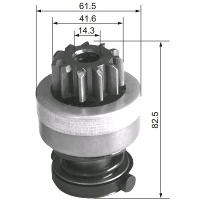
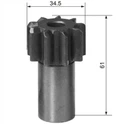
If you've ever turned the key in a car, truck, or heavy equipment ignition and felt that satisfying rumble of the engine catching, you've witnessed a small but critical component work behind the scenes: the Standard Bendix Drive. As a supplier of these drives, I've spent years walking repair techs, fleet managers, and even new mechanics through why every part in that assembly matters-but none more so than the overrunning clutch. Too often, that clutch is written off as a "tiny extra piece" until it fails, leaving a stranded vehicle or a damaged starter motor. Let's break down what this component does, how it integrates into the Bendix Drive system, and why it's non-negotiable for reliable starting.


First, let's set the stage: a Standard Bendix Drive is the engagement mechanism that connects a starter motor's pinion gear to the engine's flywheel (or flexplate, for modern vehicles) when you start the engine. When you activate the ignition, the starter motor spins the drive shaft, and the Bendix's pinion gear pushes forward to mesh with the flywheel's ring gear. That meshing transfers torque from the starter to the flywheel, cranking the engine until it fires and runs on its own. Once the engine is up and running, though, the flywheel is spinning much faster than the starter motor can-way faster, in fact. If there was nothing to separate the two, that high-speed flywheel would spin the starter's pinion at dangerous RPMs, which would shatter the pinion, burn out the starter motor, or even cause catastrophic damage to the whole starter assembly. That's exactly where the overrunning clutch comes in.
Think of the overrunning clutch as a one-way gate between two moving parts. In the Standard Bendix Drive, it sits between the starter's drive shaft and the pinion gear assembly. Its core job is simple: when torque flows from the starter to the flywheel (cranking phase), it locks up tightly, transferring that rotation without slipping. But when the engine starts, and torque reverses (with the flywheel now driving the pinion faster than the starter shaft), the clutch disengages, letting the pinion spin freely while the starter shaft slows to a stop. This is called "overrunning" - the clutch overruns the rotation of the drive shaft to protect the starter.
Let's get specific about how that works inside a typical overrunning clutch for a Bendix Drive. Most designs use a set of spring-loaded roller bearings or a sprag clutch (a series of angled, one-way metal components) housed in a cage between the drive shaft and the pinion hub. When the starter is engaged and spinning the drive shaft clockwise (to match the flywheel's rotation), the rollers or sprags wedge tightly between the inner and outer races of the clutch. That wedging creates a rigid connection, so every rotation of the drive shaft is passed directly to the pinion, which then meshes with the flywheel. Once the engine fires, the flywheel's ring gear is spinning the pinion faster than the starter shaft-let's say 3,000 RPM for the flywheel vs. 150 RPM for a typical starter at cranking. At that speed difference, the rollers or sprags stop wedging, and the clutch's springs pull them back into a position that lets the outer race (connected to the pinion) spin independently of the inner race (connected to the starter shaft). No slip, no damage, no wasted power.
Now, as a supplier, I've seen firsthand what happens when the overrunning clutch fails. Last year, a fleet manager brought in 12 starter motors for repair, all from medium-duty delivery trucks that had run for just 18 months. The issue? Their Bendix Drives had overrunning clutches that seized up. Once the engine started, the clutch didn't disengage, so the flywheel's high speed locked the pinion to the starter shaft. That forced the starter motor to spin at 3,000 RPM, which burned out the armature windings and cracked the pinion gear. Replacing those starters cost the fleet over $4,000-money they could have saved with a properly functioning overrunning clutch. That's why I always emphasize to customers that the overrunning clutch isn't a minor part; it's the main barrier between a functional start and a costly repair.
You might be wondering: how does the overrunning clutch interact with the rest of the Standard Bendix Drive assembly, not just the starter? Let's map the full system to connect the dots. The Bendix Drive itself has three key parts: the drive sleeve (that slides along the starter shaft), the pinion gear, and the overrunning clutch. The drive sleeve is splined to the starter shaft, so it can rotate with the shaft but move axially (back and forth) to engage the flywheel. When the starter is activated, a solenoid pushes the drive sleeve forward along the splines, pulling the pinion gear out of its rest position to mesh with the flywheel's ring gear. Once the pinion is engaged, the starter's torque goes through the drive sleeve, then through the overrunning clutch, to the pinion and the flywheel. Without the clutch, that torque transfer would still work for cranking, but the runaway engine damage would be inevitable. To see a visual breakdown of this assembly, you can check our Engine Starter Bendix page, which details every component, including the overrunning clutch, and how they work together during a start cycle.
It's also worth noting that overrunning clutches aren't one-size-fits-all. Different applications (light-duty passenger cars, heavy-duty semi-trucks, industrial equipment) need different clutch designs to handle varying torque loads and speed differentials. For example, a 11 Tooth Starter Bendix, common in compact passenger vehicles, uses a smaller, lighter overrunning clutch optimized for lower torque, while a heavy-duty semi-truck's Drive Starter needs a larger, higher-load sprag clutch to handle the extra force of cranking a big diesel engine. That's why working with a supplier that offers application-specific overrunning clutches is critical-using the wrong clutch for your Bendix Drive can lead to early failure, even if it fits physically. Our 11 Tooth Starter Bendix page, for instance, lists exactly which overrunning clutch models pair with each 11-tooth pinion to ensure compatibility.
Another common misconception is that overrunning clutches never need maintenance. In reality, they're wear items, just like brake pads or timing belts. The rollers or sprags wear down over time, their springs lose tension, and the clutch's inner and outer races can accumulate debris from starter brush dust or road grime. When that happens, the clutch might engage too early, slip during cranking, or fail to disengage after the engine starts. The signs are often subtle at first: a high-pitched whine right after the engine starts (that's the pinion grinding against the ring gear because the clutch is stuck engaged), or a slow cranking speed that gets worse over time (the clutch is slipping, so not all starter torque reaches the flywheel). If you notice any of these, it's time to inspect or replace the Bendix Drive-and that includes the overrunning clutch. Our Starter Bendix Replacement page walks through the steps for replacing a faulty clutch, whether you're a professional mechanic or a do-it-yourself fleet tech.
Let's touch on a few edge cases to show just how vital the overrunning clutch is. Take a marine engine: when you start a boat, the flywheel has to turn a heavy propeller, which adds extra torque during cranking. The overrunning clutch in the Bendix Drive has to handle that extra load without slipping, but also disengage quickly once the engine is running-if it doesn't, the propeller's rotational inertia can spin the starter motor so fast it disintegrates. For industrial generators, which start infrequently but need to last for 10,000+ start cycles, the overrunning clutch is designed for high durability, using a steel sprag design instead of rollers to resist wear. In both cases, removing the overrunning clutch would render the Bendix Drive useless, and likely destroy the starter motor on the first start.
As a supplier, we prioritize overrunning clutch quality because we know it's the make-or-break part of the Standard Bendix Drive. Many cheaper Bendix drives on the market use low-cost, untested clutches that fail within a year of installation. Our overrunning clutches are heat-treated for durability, spring-tension tested to ensure smooth disengagement, and matched exactly to each Bendix Drive model-whether it's a starter for a 2015 sedan or a 2020 semi-truck. You can learn more about how we design and test these clutches on our Starter Motor Drive Bendix page, which goes into detail on engineering specs for heavy-duty and light-duty applications.
If you're still wondering whether your Bendix Drive's overrunning clutch is working correctly, there's a quick test you can perform (as long as the vehicle is off and the starter is disconnected). With the pinion gear removed (or accessible), spin the starter shaft by hand. If the clutch is working, you'll feel it lock when you spin the shaft in one direction (cranking direction) and let it spin freely when you spin it in the opposite direction. If it doesn't lock in the cranking direction, or if it binds and won't spin freely in the reverse, the clutch is faulty and needs replacement. This simple test can save you from a tow bill or a costly starter repair down the line.
At the end of the day, the overrunning clutch is a masterclass in engineering: a small, often overlooked component that solves a big problem. Without it, every start would risk damaging the starter motor, the flywheel, or both. For anyone who relies on vehicles or equipment that starts with a push of a button, understanding the role of this clutch is key to maintenance and repair. If you're looking for a reliable replacement overrunning clutch for your Standard Bendix Drive, or you need help selecting the right component for your application, our team is ready to assist with procurement and technical guidance.