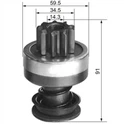
An overrunning - clutch drive is a critical component in various mechanical systems, especially in starter motors. One of the most intriguing features of an overrunning - clutch drive is its self - locking characteristic. As a supplier of overrunning - clutch drives, I am keen to share in - depth insights into this important characteristic.
Understanding the Basics of an Overrunning - Clutch Drive
Before delving into the self - locking characteristic, it's necessary to understand what an overrunning - clutch drive is. An overrunning - clutch drive is a type of clutch that allows the transmission of torque in one direction only. In a starter motor, for example, it enables the engine to be cranked by the starter motor but prevents the engine from driving the starter motor once the engine starts running.
The basic structure of an overrunning - clutch drive typically consists of an outer race, an inner race, and a set of rollers or sprags. The outer race is usually connected to the driving member, while the inner race is connected to the driven member. When the outer race rotates in the driving direction, the rollers or sprags are wedged between the outer and inner races, transmitting torque from the driving member to the driven member.
The Self - Locking Mechanism
The self - locking characteristic of an overrunning - clutch drive refers to its ability to lock the driving and driven members together when a certain torque direction and load condition are met. In a practical sense, when the starter motor is engaged and starts to rotate, the overrunning - clutch drive locks up so that the torque from the starter motor can be effectively transferred to the engine flywheel to start the engine.
The self - locking mechanism mainly relies on the geometric design of the clutch components and the frictional forces at play. When the outer race rotates in the driving direction, the rollers or sprags are forced into the narrow spaces between the outer and inner races. The friction between the rollers/sprags and the races increases rapidly, creating a wedging effect. This wedging effect is what causes the self - locking.
For example, in a Bendix System, the self - locking characteristic is of great significance. The Bendix drive is a common type of overrunning - clutch drive used in starter motors. When the starter motor is energized, the Bendix drive moves forward and meshes with the engine flywheel. At the same time, the self - locking mechanism engages, allowing the starter motor to transfer torque to the flywheel. Once the engine starts, the flywheel rotates faster than the starter motor, and the overrunning - clutch drive disengages to prevent damage to the starter motor.
Factors Affecting Self - Locking
Several factors can influence the self - locking characteristic of an overrunning - clutch drive.
1. Geometry of the Races and Rollers/Sprags
The shape and dimensions of the outer and inner races, as well as the rollers or sprags, play a crucial role. A proper wedge angle between the races and the rollers/sprags is essential for achieving effective self - locking. If the wedge angle is too large, the self - locking may be weak, and the clutch may slip under load. On the other hand, if the wedge angle is too small, the clutch may be difficult to disengage.


2. Frictional Coefficient
The frictional coefficient between the rollers/sprags and the races is another key factor. A higher frictional coefficient can enhance the self - locking ability. However, it also needs to be balanced to ensure smooth disengagement when required. The surface finish and material properties of the components affect the frictional coefficient. For example, using materials with high friction coefficients and proper surface treatments can improve the self - locking performance.
3. Load and Torque
The magnitude of the load and torque applied to the overrunning - clutch drive also impacts self - locking. Higher loads and torques generally require a more robust self - locking mechanism. If the load exceeds the self - locking capacity of the clutch, slippage may occur, leading to inefficient power transmission or even damage to the clutch.
Applications and Benefits of Self - Locking
The self - locking characteristic of overrunning - clutch drives has a wide range of applications and offers numerous benefits.
1. Starter Motors
As mentioned earlier, in starter motors, the self - locking feature is essential for starting the engine. It allows the starter motor to transfer the necessary torque to the engine flywheel to initiate the combustion process. Once the engine starts, the overrunning - clutch drive disengages, protecting the starter motor from being driven by the high - speed engine. For instance, the GM Starter Bendix utilizes the self - locking characteristic to ensure reliable engine starting.
2. Conveyor Systems
In conveyor systems, overrunning - clutch drives with self - locking can be used to prevent reverse rotation. When the power is cut off or there is a sudden load change, the self - locking clutch can hold the conveyor in place, preventing it from moving backward. This helps in maintaining the stability and safety of the conveyor system.
3. Power Tools
Some power tools also incorporate overrunning - clutch drives with self - locking. For example, in a drill, the self - locking clutch can prevent the drill bit from rotating backward when the tool is under heavy load, providing better control and safety for the user.
Quality Assurance in Overrunning - Clutch Drives with Self - Locking
As a supplier of overrunning - clutch drives, we understand the importance of quality assurance in ensuring the proper functioning of the self - locking characteristic.
1. Material Selection
We carefully select high - quality materials for the races, rollers, and sprags. These materials need to have good wear resistance, high strength, and appropriate frictional properties. For example, we use special alloys for the races to ensure long - term durability and reliable self - locking performance.
2. Precision Manufacturing
Precision manufacturing is crucial for achieving the correct geometry of the clutch components. We use advanced machining techniques and strict quality control measures to ensure that the wedge angles, surface finishes, and dimensions of the races and rollers/sprags meet the design specifications. This helps in achieving consistent and reliable self - locking performance.
3. Testing and Validation
Before the products are shipped to customers, we conduct a series of tests and validations. These include torque tests, wear tests, and disengagement tests. By simulating different operating conditions, we can ensure that the overrunning - clutch drives can provide reliable self - locking and smooth disengagement under various loads and speeds.
Contact Us for Your Overrunning - Clutch Drive Needs
If you are in need of high - quality overrunning - clutch drives with excellent self - locking characteristics, we are here to serve you. Our products are designed and manufactured to meet the highest industry standards, ensuring reliable performance in a variety of applications such as Bendix for Starter Motor. Whether you are in the automotive, industrial, or power tool industry, we can provide you with the right solutions. Contact us to discuss your specific requirements and start a procurement negotiation.
References
- Norton, R. L. (2006). Design of Machinery: An Introduction to the Synthesis and Analysis of Mechanisms and Machines. McGraw - Hill.
- Shigley, J. E., & Mischke, C. R. (2001). Mechanical Engineering Design. McGraw - Hill.