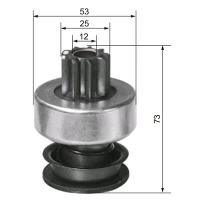
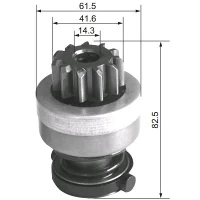
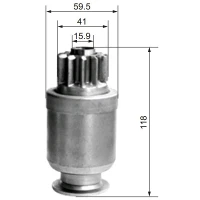
Choosing the right starter drive is not simply a matter of matching the part number. The starter drive must work correctly with the engine's ring gear, starter motor, starting torque, installation space, and operating conditions.
For OEMs, starter manufacturers, and aftermarket distributors, the wrong starter drive can lead to poor gear engagement, abnormal noise, premature tooth wear, or starting failure. The following factors should be evaluated before selecting a starter drive.
1. Start with the Engine Application
The first step is to identify the engine and its working conditions.
Passenger cars, commercial vehicles, agricultural machinery, construction equipment, and heavy-duty diesel engines can have significantly different starting requirements.
For example, a heavy-duty diesel engine generally requires higher starting torque than a passenger car engine. This means the starter drive needs to withstand higher loads during repeated engine starting cycles.
When sourcing a starter drive for OEM applications, buyers should provide the engine model, starter motor model, vehicle or equipment application, and existing starter drive information whenever available.
2. Match the Pinion Gear to the Ring Gear
The pinion gear is one of the most important specifications of a starter drive.
The number of pinion teeth must match the engine's ring gear and starter system. Tooth profile, module, pitch, and other gear dimensions also need to be compatible.
An incorrect gear match can cause:
Poor gear engagement
Excessive gear noise
Accelerated tooth wear
Difficult engine starting
Damage to the ring gear or starter drive
For a replacement or custom starter drive, buyers should therefore confirm the complete gear specifications rather than selecting a component based only on appearance.
3. Consider Starting Torque and Load
Different engines place different loads on the starter drive.
Diesel engines, large commercial engines, and equipment operating in demanding environments may require a starter drive with higher load capacity and stronger resistance to repeated impact during engagement.
The starter drive design should therefore be evaluated together with the starter motor output and engine starting torque.
For manufacturers, this is particularly important when developing a heavy-duty starter drive for commercial vehicles, trucks, agricultural machinery, or construction equipment.
4. Check the Engagement Mechanism
A starter drive must engage the ring gear smoothly and disengage correctly after the engine starts.
The drive mechanism, axial movement, spring system, overrunning function, and gear geometry all influence engagement performance.
If engagement is too slow or incomplete, the pinion may contact the ring gear incorrectly. If disengagement is delayed, the starter drive can be exposed to excessive rotational speed after the engine starts.
For this reason, starter drive selection should consider the complete operating mechanism rather than the pinion gear alone.
5. Consider Operating Environment
The same basic starter drive design may perform differently depending on the application environment.
Factors such as:
Operating temperature
Dust and contamination
Starting frequency
Vibration
Engine size
Duty cycle
Vehicle or equipment usage
can affect the required material, heat treatment, surface hardness, and durability of the starter drive.
For heavy-duty and commercial applications, durability under repeated starting cycles is particularly important.
6. Evaluate Gear Material and Heat Treatment
Starter drive gears experience impact and repeated mechanical loading. Material selection and heat treatment therefore have a direct influence on service performance.
Depending on the design and application, the gear may require appropriate surface hardness and core toughness to resist tooth wear, deformation, and fatigue.
For OEM projects, buyers should confirm not only the material grade but also the applicable heat treatment process and inspection requirements.
7. Choose the Right Starter Drive Manufacturing Method
For precision starter drive components, manufacturing technology can have a significant influence on dimensional consistency and production efficiency.
Cold extrusion is particularly suitable for certain gear components because the forming process can achieve efficient material utilization and produce a near-net-shape gear blank or component before subsequent operations.
At Superhuman, cold extrusion technology is used as an important part of precision gear component manufacturing. The manufacturing process can be developed according to the required gear geometry, material, dimensional tolerances, and production volume.
For high-volume OEM programs, buyers should evaluate not only the finished part but also the supplier's tooling, process control, heat treatment, inspection, and mass-production capability.
8. What Information Should You Provide to a Starter Drive Manufacturer?
When requesting a quotation or developing a new starter drive, providing complete technical information can significantly reduce development time.
Useful information includes:
| Information | Purpose |
|---|---|
| Engine model | Defines the application |
| Starter motor model | Confirms system compatibility |
| Pinion teeth | Determines gear matching |
| Gear dimensions | Confirms mechanical compatibility |
| Material requirement | Defines material selection |
| Heat treatment requirement | Determines hardness and durability |
| Drawing or sample | Supports accurate development |
| Annual quantity | Helps determine production and tooling requirements |
| Application environment | Supports durability evaluation |
For non-standard components, a technical drawing or physical sample is especially useful. A qualified manufacturer can then evaluate the component and determine the appropriate manufacturing route.
9. OEM vs Aftermarket Starter Drive Selection
The selection process is slightly different for OEM and aftermarket procurement.
OEM buyers normally need to consider drawing requirements, dimensional tolerances, material specifications, heat treatment, inspection standards, validation, and production consistency.
Aftermarket buyers may focus more on application coverage, interchangeability, dimensional compatibility, durability, and stable supply.
In both cases, the supplier should be able to provide consistent production quality rather than relying only on visual similarity to an existing part.
Choosing a Starter Drive: A Practical Checklist
Before ordering a starter drive, confirm these key points:
Engine and equipment application
Starter motor model
Pinion tooth count and gear specifications
Overall dimensions and mounting interface
Starting torque and operating load
Engagement and overrunning requirements
Material and heat treatment
Operating environment
Required inspection and quality standards
Annual demand and production requirements
The right starter drive is the result of matching the gear, starter motor, engine, operating conditions, and manufacturing requirements as a complete system.
For OEM and custom projects, working with a manufacturer capable of controlling cold extrusion, gear forming, heat treatment, precision machining, and inspection can help ensure stable quality from prototype development through mass production.
Superhuman manufactures starter drives and precision gear components for automotive and industrial applications, with cold extrusion and OEM/ODM development capabilities for customized requirements.