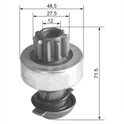
The starter drive pinion must engage correctly with the engine's ring gear before the starter motor can transfer torque effectively. Matching the number of teeth is an important first step, but it is not the only specification that determines compatibility.
For OEM buyers, starter manufacturers, and aftermarket distributors, the correct match should be evaluated based on tooth count, gear geometry, dimensions, engagement position, and the operating requirements of the starting system.
1. Start with the Pinion Tooth Count
The number of teeth on the starter drive pinion is one of the easiest specifications to identify.
Common starter drive configurations may use different pinion tooth counts depending on the engine and starter motor design. The pinion must be designed to work with the corresponding ring gear rather than simply selected by physical size.
When replacing an existing starter drive, record the exact number of pinion teeth before ordering.
However, the same tooth count does not automatically mean two starter drives are interchangeable. Other gear specifications must also be checked.
2. Check the Ring Gear Tooth Count
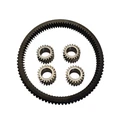
The ring gear is mounted to the engine flywheel or flexplate and provides the gear interface for the starter drive.
The relationship between the pinion and ring gear affects the mechanical advantage and starter motor speed at the engine.
A basic gear ratio can be expressed as:
Ring Gear Teeth ÷ Pinion Teeth = Starting Gear Ratio
For example, if a ring gear has 120 teeth and the starter pinion has 10 teeth:
120 ÷ 10 = 12:1
This ratio helps determine how the starter motor's rotational speed and torque are transferred to the engine.
For a replacement component, the existing system specifications should be confirmed rather than assuming that a similar-looking pinion will provide the correct ratio.
3. Tooth Count Is Not Enough
Two gears can have the same number of teeth and still fail to mesh correctly.
The following specifications should also be considered:
- Module or diametral pitch
- Pressure angle
- Tooth profile
- Gear outside diameter
- Root diameter
- Face width
- Helix angle for helical gears
- Gear orientation
Axial engagement position
These dimensions determine how the pinion teeth contact the ring gear.
An incorrect tooth profile or pitch can cause partial contact between the gears, resulting in abnormal noise, accelerated tooth wear, or difficulty engaging the engine.
4. Check the Pinion and Ring Gear Diameter
Gear diameter provides another important reference when verifying compatibility.
For a given tooth count, the pitch diameter is related to the gear's module or pitch specification. Therefore, two pinions with the same number of teeth may have different dimensions if they use different gear systems.
For this reason, procurement teams should avoid selecting a starter drive based only on:
"The pinion has the same number of teeth."
The tooth count should be verified together with the relevant gear dimensions.
5. Verify the Pressure Angle and Tooth Profile
The pressure angle determines how force is transferred between mating gear teeth.
If the pressure angle or tooth profile is incorrect, the contact pattern between the starter pinion and ring gear may be unsuitable even when the tooth count is correct.
For OEM and custom starter drive development, the manufacturer's engineering team should verify the complete gear geometry from the drawing or sample.
This is particularly important when developing a custom starter drive or replacing a non-standard component.
6. Check Gear Engagement Position
Correct gear geometry alone does not guarantee proper engagement.
The starter drive must move into the correct axial position so that the pinion engages the ring gear at the intended depth.
Insufficient engagement may result in contact near the edge of the teeth and increase the risk of tooth damage.
Excessive or incorrect engagement can also create unwanted interference.
Therefore, the pinion's overall length, mounting dimensions, axial travel, and engagement position should be checked during starter drive development.
7. Consider the Starter Motor and Engine Together
The starter drive is part of a complete starting system.
The correct combination depends on:
Starter Motor → Starter Drive → Ring Gear → Engine
The starter motor determines the available rotational speed and torque, while the pinion and ring gear determine how that torque is transmitted to the engine.
For this reason, changing the pinion tooth count without evaluating the complete system can alter the starting gear ratio and affect engine starting performance.
This is especially important for heavy-duty starter drives, diesel engines, commercial vehicles, and equipment subject to frequent starting cycles.
8. What Happens When the Pinion and Ring Gear Do Not Match?
Incorrect gear matching can produce several problems:
Abnormal Starting Noise
Poor tooth engagement can create excessive noise when the starter motor begins rotating.
Premature Tooth Wear
Improper contact concentrates the load on a smaller portion of the tooth surface, accelerating wear.
Difficulty Engaging
The pinion may fail to enter the ring gear smoothly if the gear dimensions or engagement position are incorrect.
Ring Gear Damage
The ring gear can also be damaged by repeated engagement with an incompatible starter pinion.
Starter Drive Failure
Repeated impact and excessive loading can eventually lead to tooth breakage or other component failure.
These problems can be avoided by confirming the complete gear interface before production or replacement.
9. Information to Provide When Ordering a Starter Drive
For an accurate quotation or custom development project, buyers should provide as much of the following information as possible:
| Parameter | Why It Matters |
|---|---|
| Pinion tooth count | Identifies the basic gear configuration |
| Ring gear tooth count | Helps establish the gear ratio |
| Module / diametral pitch | Defines tooth size |
| Pressure angle | Determines tooth geometry |
| Gear outside diameter | Helps verify dimensional compatibility |
| Face width | Determines available tooth contact area |
| Helix angle | Required for helical gear matching |
| Overall dimensions | Confirms installation compatibility |
| Starter motor model | Identifies the starting system |
| Engine model | Defines the application |
| Drawing or sample | Allows detailed engineering verification |
For a starter drive manufacturer, a technical drawing is the preferred reference because it provides dimensional tolerances and other specifications that may not be visible from a physical sample.
10. How Manufacturers Verify Starter Drive Gear Compatibility
For OEM production, gear matching should be verified during engineering and production rather than relying only on visual inspection.
A typical process may include:
- Review the customer's drawing or sample
- Confirm pinion and ring gear specifications
- Evaluate gear geometry and engagement requirements
- Select the appropriate material and manufacturing process
- Develop or modify the forming tooling when required
- Manufacture trial samples
- Inspect critical gear dimensions
- Verify tooth profile and runout
- Conduct functional or durability testing when required
- Approve the component for mass production
For manufacturers using cold extrusion gear manufacturing, the forming process and tooling design must also be considered during development. Material flow, die design, dimensional control, and subsequent machining or heat treatment can all influence the final gear performance.
A Practical Checklist for Matching Starter Drive Pinion Teeth
Before purchasing or developing a starter drive, confirm:
- Pinion tooth count
- Ring gear tooth count
- Gear ratio
- Module or diametral pitch
- Pressure angle
- Tooth profile
- Gear diameter
- Face width
- Helix angle, if applicable
- Axial engagement position
- Starter motor model
- Engine application
- Drawing or sample
The key point is simple: matching the pinion tooth count is only the starting point.
A reliable starter drive requires the pinion and ring gear to match in tooth geometry, dimensions, engagement position, and operating requirements. For OEM and custom applications, these parameters should be verified before tooling and mass production begin.
For customers developing non-standard starter drives, Superhuman can evaluate drawings or samples and develop the appropriate manufacturing process for the required gear configuration, including cold extrusion, subsequent processing, inspection, and OEM production.