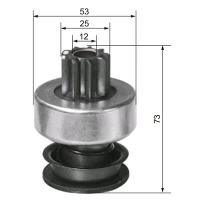
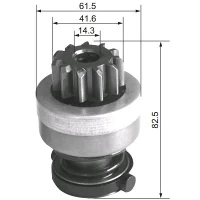
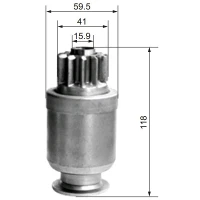
The starter drive gear ratio determines how the starter motor's speed and torque are transferred to the engine. For OEM buyers, it is therefore an important parameter when selecting, replacing, or developing a starter drive.
However, the gear ratio should not be evaluated by pinion tooth count alone. Ring gear teeth, starter motor characteristics, engine starting requirements, gear geometry, and engagement conditions all need to be considered together.
1. How Is the Starter Drive Gear Ratio Calculated?
The basic starting gear ratio is calculated by dividing the number of teeth on the engine ring gear by the number of teeth on the starter drive pinion:
Starter Drive Gear Ratio = Ring Gear Teeth ÷ Pinion Teeth
For example, a system with a 120-tooth ring gear and a 10-tooth pinion has a:
120 ÷ 10 = 12:1 gear ratio
This means the starter motor rotates approximately 12 times for one revolution of the engine crankshaft, assuming the gears are directly engaged.
A higher numerical ratio generally provides greater torque multiplication at the engine, while the starter motor must rotate faster relative to engine speed.
2. Why Does Gear Ratio Matter for Engine Starting?
An engine requires sufficient torque to overcome compression, internal friction, oil resistance, and other mechanical loads during starting.
The starter motor provides the initial rotational force, while the starter drive transfers this force through the pinion and ring gear.
The gear ratio affects this torque and speed relationship.
For this reason, changing the pinion tooth count can change the operating characteristics of the entire starting system.
OEM buyers should not treat the pinion as an isolated replacement component. The starter motor, starter drive, ring gear, and engine should be evaluated as one system.
3. What Should OEM Buyers Check?
Before approving a starter drive, OEM procurement and engineering teams should verify several key parameters.
Ring Gear Tooth Count
The ring gear tooth count provides the first reference for calculating the starting gear ratio.
It should be confirmed from the engine or flywheel specification rather than estimated from an existing component.
Pinion Tooth Count
The starter drive pinion determines the second part of the gear ratio.
Even a small change in tooth count can alter the ratio, so the replacement pinion should not be selected solely because it physically fits the starter motor.
Starter Motor Speed
The starter motor's rated speed must be considered together with the gear ratio.
If the motor rotates at a particular speed, the resulting engine cranking speed depends partly on the reduction provided by the starter drive and ring gear.
Starter Motor Torque
The gear ratio affects how motor torque is transferred to the engine.
A suitable configuration needs to provide sufficient cranking torque without placing excessive loads on the gears or starter components.
Engine Starting Requirements
Engine displacement, compression, temperature, lubrication conditions, and application all influence the torque required during starting.
A passenger vehicle, commercial truck, agricultural machine, and heavy-duty diesel engine may therefore require different starter system configurations.
4. Does More Reduction Always Mean Better Starting Performance?
Not necessarily.
A higher numerical gear ratio can increase torque multiplication at the engine, but it also changes the relationship between starter motor speed and engine speed.
The complete starting system must remain within the operating range of the starter motor and engine.
OEM engineers should therefore consider:
- Required engine cranking speed
- Available starter motor torque
- Starter motor rated speed
- Engine starting resistance
- Pinion and ring gear strength
- Engagement characteristics
- Duty cycle
- Operating temperature
The objective is not simply to obtain the highest possible gear ratio, but to establish the appropriate balance between starting torque, cranking speed, durability, and system compatibility.
5. What Happens If the Gear Ratio Is Incorrect?
An unsuitable gear ratio can create problems even when the starter drive physically fits the application.
Potential issues include:
Insufficient cranking speed
The engine may not reach the required starting speed.
Insufficient starting torque
The starter may struggle to overcome engine resistance, particularly under demanding conditions.
Excessive mechanical loading
An unsuitable configuration can increase loads on the pinion, ring gear, starter motor, or related components.
Premature gear wear
Repeated high-impact engagement or excessive tooth loading can accelerate wear.
Poor starting performance
The engine may take longer to start or fail to start reliably under certain operating conditions.
6. Gear Ratio Is Not the Only Gear Specification
A correct tooth-count ratio does not automatically mean the starter drive and ring gear are compatible.
OEM buyers should also verify:
- Module or diametral pitch
- Pressure angle
- Tooth profile
- Pinion outside diameter
- Root diameter
- Face width
- Helix angle, where applicable
- Gear runout
- Axial engagement position
These parameters determine whether the pinion and ring gear can engage correctly and transfer load effectively.
For a custom starter drive, the manufacturer's engineering team should verify the complete gear geometry before tooling development.
7. What About Heavy-Duty Diesel Applications?
Heavy-duty diesel engines can place significantly higher demands on the starting system, especially in commercial vehicles, construction equipment, agricultural machinery, and other applications operating under difficult conditions.
OEM buyers should consider the required starting torque together with:
- Engine displacement
- Compression ratio
- Starter motor output
- Ambient temperature
- Starting frequency
- Duty cycle
- Gear tooth strength
- Heat treatment
- Expected service life
A heavy-duty starter drive should therefore be evaluated according to the complete application rather than selected solely by tooth count or gear ratio.
8. What Information Should Be Included in an OEM RFQ?
Providing complete technical information allows a starter drive manufacturer to evaluate the application more accurately.
An OEM RFQ should ideally include:
| Parameter | Information Required |
|---|---|
| Engine model | Exact engine or equipment application |
| Starter motor | Model, rated voltage, speed and torque |
| Ring gear | Tooth count and relevant gear dimensions |
| Pinion | Tooth count and gear specifications |
| Gear ratio | Existing or required ratio |
| Drawing | Dimensions and tolerances |
| Material | Required grade or supplier specification |
| Heat treatment | Hardness or process requirement |
| Annual volume | Expected production quantity |
| Application | Vehicle, engine or equipment type |
| Validation | Required testing or approval standards |
A drawing or physical sample is particularly useful when developing a non-standard starter drive.
9. How Manufacturers Control Gear Ratio During Production
For OEM production, gear ratio starts with the correct gear design and continues through dimensional control during manufacturing.
For precision starter drive components, the manufacturing process may include cold extrusion, machining, heat treatment, and gear inspection depending on the required design.
Cold extrusion gear manufacturing can be used for suitable gear geometries to efficiently form components while maintaining controlled material flow and dimensional consistency.
After forming and subsequent processing, critical gear dimensions and characteristics should be inspected according to the customer's specifications.
For high-volume automotive programs, process consistency is particularly important because a small dimensional variation repeated across production can affect the performance of the complete starting system.
10. Starter Drive Gear Ratio Checklist for OEM Buyers
Before approving a starter drive, verify:
- Ring gear tooth count
- Pinion tooth count
- Calculated gear ratio
- Starter motor speed
- Starter motor torque
- Required engine cranking speed
- Engine starting torque requirements
- Gear module or diametral pitch
- Pressure angle and tooth profile
- Pinion dimensions and engagement position
- Material and heat treatment
- Gear inspection requirements
- Expected production volume
- Required durability or validation testing
Final Consideration
The correct starter drive gear ratio is determined by the relationship between the starter motor, pinion, ring gear, and engine-not by tooth count alone.
For OEM procurement, the safest approach is to verify the required ratio together with gear geometry, starter motor performance, engine requirements, material, heat treatment, and production tolerances.
For custom and OEM projects, Superhuman can evaluate customer drawings or samples and develop starter drive and precision gear components according to the required application, manufacturing process, inspection requirements, and production volume.