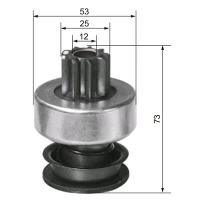
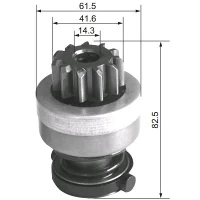
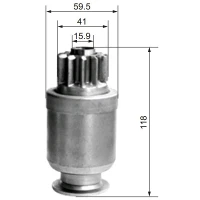
A starter drive is exposed to repeated gear engagement, torque transmission, vibration, and mechanical impact every time the engine starts. When a starter drive fails much earlier than expected, the cause is not always the component itself.
Incorrect gear matching, poor heat treatment, excessive starting load, inadequate lubrication, manufacturing variation, and problems elsewhere in the starting system can all contribute to premature failure.
For OEM buyers and starter manufacturers, identifying the actual failure mechanism is essential before changing the component specification or supplier.
1. Incorrect Pinion and Ring Gear Matching
One of the most common causes of starter drive problems is an incompatible gear interface.
The pinion and ring gear need to match in more than just tooth count. Important parameters include:
- Pinion tooth count
- Ring gear tooth count
- Module or diametral pitch
- Pressure angle
- Tooth profile
- Gear diameter
- Face width
- Helix angle, where applicable
- Engagement position
If these specifications are not properly matched, the teeth may contact incorrectly during engine starting.
This can produce abnormal noise, localized tooth loading, accelerated wear, and eventually tooth damage.
2. Excessive Starting Load
The starter drive must transfer the torque generated by the starter motor to the engine.
A cold engine, high-compression diesel engine, heavy-duty application, or difficult starting condition can significantly increase the load placed on the starter drive.
If the actual starting load exceeds the design conditions, the pinion teeth may experience excessive bending and contact stress.
For this reason, a heavy-duty starter drive should be evaluated according to the complete engine and starter system rather than simply increasing the size of the gear.
3. Insufficient or Incorrect Heat Treatment
Starter drive gears need an appropriate combination of surface hardness and core toughness.
If the surface is too soft, the gear may experience rapid wear and deformation.
If the material becomes excessively hard without sufficient core toughness, the component may become more susceptible to cracking or tooth breakage under impact loading.
Heat treatment therefore needs to be controlled according to the material, gear design, load conditions, and required service life.
For OEM production, hardness and heat-treatment requirements should be clearly defined and verified rather than treated as secondary specifications.
4. Poor Tooth Profile or Dimensional Accuracy
A starter drive can have the correct tooth count and still fail if the gear geometry is not accurately controlled.
Variations in tooth profile, pitch, runout, concentricity, or other critical dimensions can affect the contact pattern between the pinion and ring gear.
Poor contact distribution can concentrate the load on a limited area of the tooth surface.
Over time, this may result in:
- Pitting
- Tooth wear
- Tooth deformation
- Chipping
- Tooth breakage
For precision starter drive manufacturing, dimensional inspection and gear testing are therefore important parts of quality control.
5. Improper Engagement or Disengagement
The starter drive needs to move into engagement with the ring gear at the correct position and disengage after the engine starts.
If engagement is incomplete, the pinion may contact the edge rather than the intended working portion of the ring gear teeth.
If disengagement does not occur correctly, the starter drive can continue rotating at an excessively high speed after the engine has started.
Both conditions can increase mechanical stress and shorten component life.
When diagnosing a failed starter drive, the engagement mechanism and starter assembly should therefore be inspected together with the gear teeth.
6. Excessive Starting Frequency
A starter drive designed for occasional passenger-car starting may not be suitable for an application involving frequent engine starts.
Commercial vehicles, agricultural machinery, construction equipment, generators, and other equipment may have significantly different duty cycles.
Repeated engagement increases cumulative mechanical and thermal loading.
When selecting a starter drive for OEM applications, buyers should provide information about the expected starting frequency and operating cycle so that the component can be evaluated for the actual application.
7. Material Selection Problems
The material needs to provide the appropriate balance of strength, toughness, wear resistance, and manufacturability.
Using an unsuitable material or inconsistent raw material can affect the performance of the finished gear.
For OEM projects, buyers should define the required material grade and applicable material documentation. The manufacturer should also maintain traceability and appropriate incoming material inspection.
Material selection becomes particularly important when developing a custom starter drive for a new engine or equipment application.
8. Manufacturing Process Variation
The manufacturing process can also influence starter drive durability.
For precision gear components, factors such as forming accuracy, material flow, machining, heat treatment, and final inspection all contribute to the finished component.
Cold extrusion can be an efficient manufacturing method for suitable gear geometries, but tooling condition, lubrication, forming parameters, and dimensional control need to remain stable throughout production.
For high-volume OEM supply, controlling process variation is just as important as producing a correct initial sample.
9. Lubrication and Contamination
Lubrication conditions can affect the movement and operation of the starter drive mechanism.
Insufficient lubrication, unsuitable lubricant, contamination, or excessive debris can increase friction and interfere with smooth engagement and disengagement.
However, lubrication should not be used to compensate for incorrect gear geometry or mechanical problems.
If a starter drive shows abnormal wear, the surrounding components and operating environment should be inspected before assuming that lubrication alone is the cause.
10. Problems with the Ring Gear
A new starter drive can fail prematurely because of a worn or damaged ring gear.
If the ring gear has damaged teeth, excessive wear, or an abnormal contact pattern, the replacement pinion will be exposed to the same problem.
This is particularly important when replacing only the starter drive while leaving an old ring gear in service.
When investigating repeated starter drive failures, both sides of the gear interface should be inspected.
11. Incorrect Starter Motor Output
The starter motor is another potential source of excessive loading.
If the motor produces a different torque or speed from the original system specification, the starter drive may experience operating conditions outside its intended range.
OEM engineers should therefore verify the relationship between:
Starter Motor → Starter Drive → Ring Gear → Engine
Changing one component without checking the complete system can create an unexpected load or speed condition.
12. How Should OEM Buyers Analyze a Failed Starter Drive?
When a starter drive fails prematurely, replacing the part immediately may not solve the underlying problem.
A practical failure analysis should include:
| Inspection Area | What to Check |
|---|---|
| Pinion teeth | Wear, chipping, cracking, deformation |
| Ring gear | Tooth damage and wear pattern |
| Gear geometry | Tooth profile, pitch, runout and dimensions |
| Material | Grade and material consistency |
| Hardness | Surface and core hardness |
| Heat treatment | Required process and actual results |
| Engagement | Axial movement and contact position |
| Starter motor | Speed and torque |
| Operating conditions | Temperature, duty cycle and starting frequency |
| Lubrication | Condition and contamination |
| Manufacturing records | Process and inspection data |
The failure pattern often provides useful information about the underlying cause.
For example, localized tooth wear may indicate an engagement or gear-matching problem, while tooth breakage may require investigation of impact loading, material properties, heat treatment, or excessive torque.
13. How Can Premature Starter Drive Failure Be Reduced?
A reliable starter drive starts with correct engineering rather than simply adding material or increasing dimensions.
OEM buyers and manufacturers should focus on:
- Correct pinion and ring gear matching
- Appropriate gear geometry
- Suitable material selection
- Controlled heat treatment
- Accurate manufacturing
- Proper engagement and disengagement
- Appropriate starter motor matching
- Application-specific durability requirements
- Consistent production processes
- Final dimensional and functional inspection
For custom projects, these requirements should be established during product development rather than after the first production failure.
Final Consideration
Premature starter drive failure is usually the result of a combination of mechanical, material, manufacturing, or application factors.
The key is to identify the failure mechanism instead of simply replacing the damaged component.
For OEM and aftermarket applications, a reliable starter drive manufacturer should be able to evaluate gear geometry, materials, heat treatment, manufacturing processes, and inspection requirements as part of the complete component development process.
Superhuman supports customized starter drive and precision gear development, including cold extrusion manufacturing, subsequent processing, dimensional inspection, and OEM production according to customer drawings, samples, and application requirements.