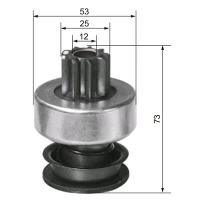
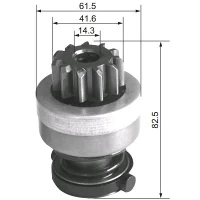
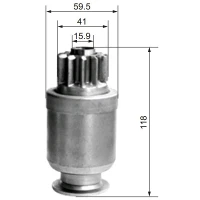
Abnormal noise during engine starting is often one of the earliest signs of a problem with the starter drive system. A grinding, clicking, whirring, or harsh engagement sound may indicate incorrect gear matching, poor engagement, excessive wear, or a problem with the starter motor.
For OEM buyers and starter manufacturers, the important question is not simply whether a starter drive is noisy. The sound should be evaluated together with the gear condition, engagement position, starter motor, and ring gear to identify the actual cause.
1. Grinding Noise During Starter Engagement
A grinding sound when the engine begins to crank commonly indicates poor contact between the starter drive pinion and the engine ring gear.
Possible causes include:
- Incorrect pinion and ring gear matching
- Incorrect tooth profile
- Improper engagement depth
- Damaged gear teeth
- Insufficient axial movement
- Worn ring gear teeth
When the pinion does not enter the ring gear correctly, the gear teeth can collide rather than engage smoothly.
Repeated grinding can quickly damage both the starter drive and the ring gear.
2. Clicking or Repeated Engagement Noise
A clicking sound may occur when the starter drive repeatedly attempts to engage the ring gear but cannot maintain proper engagement.
The cause may be related to the engagement mechanism, starter solenoid, insufficient starter motor power, or excessive resistance in the engine.
The starter drive should therefore not be replaced immediately based only on a clicking noise.
The complete starting system should be checked to determine whether the drive is actually the source of the problem.
3. Whining or High-Speed Noise After Engine Starts
A high-pitched or rapidly increasing sound after the engine starts may indicate that the starter drive is not disengaging correctly.
Once the engine has started, the engine can rotate the ring gear faster than the starter motor. The starter drive's overrunning mechanism helps protect the starter motor from excessive rotational speed.
If the drive remains engaged when it should disengage, the starter drive and starter motor can be subjected to unnecessary mechanical stress.
This condition should be addressed promptly because continued operation can shorten component life.
4. Noise Caused by Incorrect Pinion and Ring Gear Matching
Gear compatibility is one of the first areas to investigate when abnormal starter noise occurs.
The pinion and ring gear should be matched according to:
- Tooth count
- Module or diametral pitch
- Pressure angle
- Tooth profile
- Gear diameter
- Face width
- Helix angle, where applicable
- Engagement position
Matching tooth count alone is not sufficient.
Two gears may have the same number of teeth but different geometry, resulting in poor contact and abnormal noise during starting.
For OEM applications, the complete gear specification should be verified before approving a starter drive.
5. Noise Caused by Worn Gear Teeth
A worn starter pinion or ring gear can produce increasingly noticeable noise during engagement.
Typical signs include:
- Rounded tooth edges
- Pitting
- Chipped teeth
- Uneven tooth wear
- Localized contact marks
- Damaged tooth tips
If only the starter drive is replaced while a severely worn ring gear remains in service, the new component may continue to experience abnormal engagement.
For repeated noise complaints, both the pinion and ring gear should therefore be inspected.
6. Noise Caused by Incorrect Engagement Position
The pinion needs to move into the correct axial position before transferring significant torque.
If engagement is too shallow, the teeth may contact near their edges instead of across the intended working area.
This can create impact noise and concentrated tooth loading.
If engagement is too deep or the components interfere, the result can also be abnormal contact and increased mechanical resistance.
For a custom starter drive, the axial dimensions and movement requirements should be confirmed during engineering development.
7. Starter Motor Problems Can Also Cause Noise
Not every starting noise originates from the starter drive.
A starter motor with abnormal speed, insufficient torque, electrical problems, or mechanical wear can affect the way the pinion engages the ring gear.
OEM engineers should evaluate:
Starter Motor → Starter Drive → Ring Gear → Engine
as one operating system.
If the starter motor does not provide the expected rotational speed or torque, the starter drive may engage under abnormal conditions.
8. Gear Manufacturing Accuracy Matters
Gear geometry has a direct influence on engagement noise.
Variations in tooth profile, pitch, runout, concentricity, or other critical dimensions can change the contact pattern between the pinion and ring gear.
For precision starter drive manufacturing, manufacturers should control critical gear dimensions throughout production rather than relying only on final visual inspection.
Depending on the component design, manufacturing may involve cold extrusion, machining, heat treatment, and gear inspection.
Consistent process control is particularly important for high-volume OEM programs.
9. Heat Treatment Can Affect Gear Noise and Durability
Heat treatment primarily affects hardness, strength, wear resistance, and toughness, but it can also influence dimensional stability.
If heat treatment is not properly controlled, dimensional changes or inadequate material properties may affect the final gear performance.
A starter drive with insufficient surface hardness may develop accelerated tooth wear, while unsuitable material properties can increase the risk of tooth damage under repeated impact.
For OEM procurement, material and heat-treatment requirements should therefore be clearly specified and verified.
10. How Can OEM Buyers Diagnose Starter Drive Noise?
When a noise complaint occurs, the following information can help identify the cause:
| Check | What to Look For |
|---|---|
| Noise timing | During engagement, cranking, or after engine start |
| Pinion teeth | Wear, chipping, pitting or deformation |
| Ring gear | Damaged or unevenly worn teeth |
| Tooth contact | Proper and consistent contact pattern |
| Engagement | Correct axial movement and depth |
| Starter motor | Speed, torque and electrical condition |
| Gear geometry | Tooth profile, pitch and runout |
| Material | Correct material grade |
| Hardness | Required surface and core hardness |
| Operating conditions | Temperature and starting frequency |
The timing of the noise is particularly useful.
A grinding sound during engagement points toward gear matching or engagement issues, while a high-speed whine after engine startup may indicate a disengagement or overrunning problem.
11. How to Reduce Starter Drive Noise
Reducing starter drive noise starts with correct system matching and manufacturing control.
OEM manufacturers should focus on:
- Correct pinion and ring gear specifications
- Accurate tooth geometry
- Proper engagement depth
- Appropriate material selection
- Controlled heat treatment
- Consistent manufacturing tolerances
- Correct starter motor matching
- Proper ring gear condition
- Functional testing when required
- Inspection of critical gear characteristics
For high-volume production, the objective should be consistent engagement performance from the first production sample through mass production.
12. What Should Be Included in an OEM Starter Drive Specification?
When sourcing or developing a custom starter drive, the technical specification should ideally include:
- Pinion tooth count
- Ring gear specifications
- Module or diametral pitch
- Pressure angle
- Tooth profile
- Gear dimensions
- Axial engagement requirements
- Material
- Heat treatment
- Hardness requirements
- Dimensional tolerances
- Inspection requirements
- Functional or durability testing requirements
Providing a detailed drawing or production sample can help the manufacturer evaluate the component more accurately.
Final Consideration
Starter drive noise is often a symptom rather than the root cause.
Incorrect gear matching, damaged teeth, poor engagement, manufacturing variation, starter motor problems, and ring gear wear can all contribute to abnormal starting noise.
For OEM buyers, the most effective approach is to evaluate the starter motor, starter drive, and ring gear as a complete system and identify the actual failure mechanism before changing the component specification.
Superhuman manufactures starter drives and precision gear components for OEM and aftermarket applications, with capabilities covering cold extrusion, subsequent processing, inspection, and customized production according to customer drawings and samples.