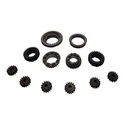
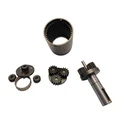
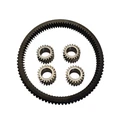
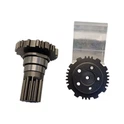
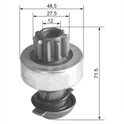
At Wuxi Superhuman Gear Cold Extrusion Co., Ltd., we've cold-formed thousands of pinion gears for Bendix drive assemblies. And the question we hear most often isn't "What's a Bendix drive?" but "Which component actually fails first-and how do we prevent it?" The answer comes from disassembling returned units, not just reading catalogs.
Last autumn, a client developing a commercial vehicle starter reported intermittent no-crank complaints in cold weather. After receiving field-return samples, we sectioned several Bendix drives and found a pattern: the pinion gear teeth showed minimal wear, but the return spring had lost tension, and the overrunning clutch rollers exhibited micro-brinelling. The root cause wasn't one failed part-it was how the three core components interacted under real-world stress.
The Pinion Gear: Precision Engagement Starts Here
The pinion gear is the Bendix drive's "handshake" with the engine. Its job is simple in theory-mesh cleanly with the flywheel ring gear and transmit cranking torque. But in practice, tooth profile, surface hardness, and dimensional consistency determine whether engagement is smooth or harsh.
At Superhuman Gear, we cold-extrude pinion teeth rather than cutting them. Why? Cold forming aligns the metal's grain structure along the tooth profile, improving fatigue resistance and surface durability. One heavy-duty starter client saw a 40% reduction in tooth chipping after switching to our cold-extruded pinions-because the material simply handles impact loads better.
Key gear factors we control:
- Tooth profile accuracy for quiet, positive engagement
- Core hardness vs. surface hardness balance for wear resistance
- Dimensional consistency to ensure reliable spline travel
The Return Spring: Small Part, Big Impact on Reliability
The return spring seems simple-a coil that pulls the pinion back after startup. But its performance directly affects engagement timing and disengagement safety.
A recent project illustrated this well. A client's starter worked perfectly at room temperature but showed delayed pinion retraction below -20°C. After testing, we found the spring material's modulus shifted with temperature, reducing return force. By specifying a cold-rated alloy and optimizing coil geometry, we restored consistent retraction across the full temperature range.
Practical spring considerations:
- Material selection for temperature stability
- Spring rate tuned to pinion mass and lubricant viscosity
- End configuration to prevent binding during travel
The Overrunning Clutch: Protecting the Starter Motor
Perhaps the most critical component, the overrunning clutch (often a roller or sprag type) allows torque transfer in one direction only. When the engine starts and spins faster than the starter, the clutch "freewheels," preventing catastrophic back-driving.
We've seen clutch failures traced to subtle issues: roller surface finish affecting engagement smoothness, cage geometry influencing load distribution, or lubricant compatibility impacting long-term performance. One marine starter application required stainless clutch components to resist saltwater corrosion-something standard carbon steel couldn't handle.
How We Help Clients Optimize Bendix Components
At Wuxi Superhuman Gear, we don't just supply individual parts. When a client shares a starter reliability challenge, we evaluate the entire Bendix system:
- Analyze pinion gear geometry for optimal engagement dynamics
- Validate spring performance across expected temperature ranges
- Test clutch components under simulated overrun conditions
- Optimize material selection and heat treatment for durability
The Bottom Line
The Bendix drive isn't a single component-it's a precisely coordinated system of gear, spring, and clutch. Each part must perform reliably on its own and in harmony with the others. At Wuxi Superhuman Gear Cold Extrusion Co., Ltd., we engineer starter components based on measured performance data and field-proven reliability. Because in automotive systems, the best components aren't the ones you notice-they're the ones that work silently, start after start, year after year.
# What Are the Main Components of a Bendix Drive? Gear, Spring and Clutch Explained
At Wuxi Superhuman Gear Cold Extrusion Co., Ltd., we've cold-formed thousands of pinion gears for Bendix drive assemblies. And the question we hear most often isn't "What's a Bendix drive?" but "Which component actually fails first-and how do we prevent it?" The answer comes from disassembling returned units, not just reading catalogs.
Last autumn, a client developing a commercial vehicle starter reported intermittent no-crank complaints in cold weather. After receiving field-return samples, we sectioned several Bendix drives and found a pattern: the pinion gear teeth showed minimal wear, but the return spring had lost tension, and the overrunning clutch rollers exhibited micro-brinelling. The root cause wasn't one failed part-it was how the three core components interacted under real-world stress.
The Pinion Gear: Precision Engagement Starts Here
The pinion gear is the Bendix drive's "handshake" with the engine. Its job is simple in theory-mesh cleanly with the flywheel ring gear and transmit cranking torque. But in practice, tooth profile, surface hardness, and dimensional consistency determine whether engagement is smooth or harsh.
At Superhuman Gear, we cold-extrude pinion teeth rather than cutting them. Why? Cold forming aligns the metal's grain structure along the tooth profile, improving fatigue resistance and surface durability. One heavy-duty starter client saw a 40% reduction in tooth chipping after switching to our cold-extruded pinions-because the material simply handles impact loads better.
Key gear factors we control:
- Tooth profile accuracy for quiet, positive engagement
- Core hardness vs. surface hardness balance for wear resistance
- Dimensional consistency to ensure reliable spline travel
The Return Spring: Small Part, Big Impact on Reliability
The return spring seems simple-a coil that pulls the pinion back after startup. But its performance directly affects engagement timing and disengagement safety.
A recent project illustrated this well. A client's starter worked perfectly at room temperature but showed delayed pinion retraction below -20°C. After testing, we found the spring material's modulus shifted with temperature, reducing return force. By specifying a cold-rated alloy and optimizing coil geometry, we restored consistent retraction across the full temperature range.
Practical spring considerations:
- Material selection for temperature stability
- Spring rate tuned to pinion mass and lubricant viscosity
- End configuration to prevent binding during travel
The Overrunning Clutch: Protecting the Starter Motor
Perhaps the most critical component, the overrunning clutch (often a roller or sprag type) allows torque transfer in one direction only. When the engine starts and spins faster than the starter, the clutch "freewheels," preventing catastrophic back-driving.
We've seen clutch failures traced to subtle issues: roller surface finish affecting engagement smoothness, cage geometry influencing load distribution, or lubricant compatibility impacting long-term performance. One marine starter application required stainless clutch components to resist saltwater corrosion-something standard carbon steel couldn't handle.
How We Help Clients Optimize Bendix Components
At Wuxi Superhuman Gear, we don't just supply individual parts. When a client shares a starter reliability challenge, we evaluate the entire Bendix system:
- Analyze pinion gear geometry for optimal engagement dynamics
- Validate spring performance across expected temperature ranges
- Test clutch components under simulated overrun conditions
- Optimize material selection and heat treatment for durability
The Bottom Line
The Bendix drive isn't a single component-it's a precisely coordinated system of gear, spring, and clutch. Each part must perform reliably on its own and in harmony with the others. At Wuxi Superhuman Gear Cold Extrusion Co., Ltd., we engineer starter components based on measured performance data and field-proven reliability. Because in automotive systems, the best components aren't the ones you notice-they're the ones that work silently, start after start, year after year.