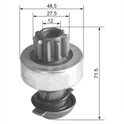
When customers contact us at Wuxi Superhuman Gear Cold Extrusion Co., Ltd., this is a question that comes up quite often-especially during troubleshooting or sourcing: "Are the Bendix drive and the overrunning clutch the same thing?"
The short answer is no. But in real applications, the confusion is understandable, because the two are closely connected and often work together inside the starter system.
1. The simplest way to understand the difference
In practical terms:
Bendix Drive → the complete starter drive assembly
Overrunning Clutch → a key component inside the Bendix drive
So when people refer to a "Bendix drive," they are usually talking about the entire mechanism that connects the starter motor to the engine. The overrunning clutch is just one part of that system-but a very important one.
2. What does the Bendix drive actually include?
A typical Bendix drive consists of:
Pinion gear (engages with the flywheel)
Shaft with spline or sliding mechanism
Return spring or movement system
Overrunning clutch (internal component)
Its job is to:
- Move forward to engage
- Transmit torque from the starter motor
- Disengage after the engine starts
We often describe it to customers as the "bridge" between the starter motor and the engine.
3. What is the overrunning clutch's role?
The overrunning clutch has a very specific function:
- It allows torque to transfer in one direction only
- It prevents the engine from driving the starter motor backward
In real operation:
When the starter motor turns → the clutch locks and transmits torque
When the engine starts and spins faster → the clutch releases and "overruns"
We've seen cases where this component failed, and the result was serious damage to the starter motor because it was forced to rotate at engine speed.
So while it's just one part, it acts as a critical safety mechanism.
4. Why the confusion happens in real projects
In actual communication, especially in aftermarket or repair situations, customers often use the terms interchangeably.
For example, a customer once told us: "The overrunning clutch is broken-we need a Bendix."
After further discussion, it became clear they needed the entire drive assembly, not just the internal clutch.
This happens because:
The clutch failure often leads to replacing the whole Bendix drive
The components are integrated and not always serviced separately
5. Functional difference in real use
From our experience at Wuxi Superhuman Gear Cold Extrusion Co., Ltd.:
The Bendix drive controls movement and engagement
The overrunning clutch controls torque direction and protection
If the Bendix fails:
The gear may not engage the flywheel
If the clutch fails:
The starter may spin freely without turning the engine
Or worse, the starter may be damaged after engine startup
6. Why manufacturing quality matters for both
Although they serve different roles, both components depend heavily on precision manufacturing.
In our production process, we pay close attention to:
- Gear accuracy for smooth engagement
- Clutch internal structure for reliable locking and release
- Material strength for repeated stress cycles
We've worked with customers who experienced early clutch component failure due to low-quality components. Even when the rest of the Bendix drive looked fine, the internal clutch determined overall reliability.
Final thoughts from real-world experience
At Wuxi Superhuman Gear Cold Extrusion Co., Ltd., we see the Bendix drive and overrunning clutch as parts of the same system-but with clearly different responsibilities.
The Bendix drive handles engagement and motion, while the overrunning clutch ensures safe torque transfer and protection.
Understanding this distinction helps not only in technical discussions, but also in sourcing the correct components and avoiding unnecessary replacements. In real applications, knowing exactly which part is responsible for the problem can save both time and cost.