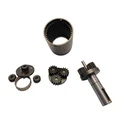
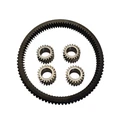
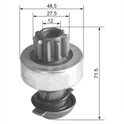
The working principle of the automobile starter is the energy conversion process based on Ampere's Law that is encountered in junior high school physics, that is, the force acting on the energized conductor in the magnetic field. The motor includes necessary armature, commutator, magnetic pole, brush, bearing, housing and other components.
Before the engine runs under its own power, it must rotate with the help of external forces. The process in which an engine transits from a static state to a self running state with the help of external forces is called engine starting. The commonly used starting methods of engine include manual starting, auxiliary gasoline engine starting and electric starting. The differences are as follows:
1. Manual starting adopts rope pulling or hand cranking, which is simple but inconvenient and labor intensive. It is only applicable to some small power engines, and it is reserved as a backup mode on some cars;
2. The auxiliary gasoline engine starting is mainly used for high-power diesel engines;
3. The electric starting mode is easy to operate, fast to start, has the ability of repeated starting, and can be controlled remotely, so it is widely used by modern cars.