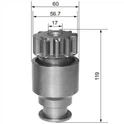
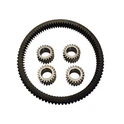
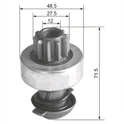
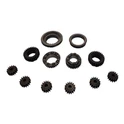
If you've ever stood behind a workshop bay as a technician yanks a key, listens to that high-pitched "grind" that means a bad starter gear, you know the Bendix drive is the unsung hero that either makes or breaks the cranking process. As a supplier of starter motor gear Bendix drives, I've spent more hours than I can count walking customers through why this small, unassuming component matters so much-and most of all, why nailing its torque specifications isn't just a recommendation, it's non-negotiable.
A Bendix drive, for anyone who's not deep in the weeds of automotive parts, is the part that sits at the end of your starter motor's shaft. When you turn the key, it pushes out to mesh with the flywheel ring gear, spins the engine over to start it, and then retracts back before the flywheel can spin it faster than the starter motor itself (that's called overrun, and it's what keeps your starter from blowing up). The torque specs for this part aren't random numbers plucked from a parts catalog-they're calculated to make sure the drive engages reliably, holds steady during cranking, and disengages cleanly the second the engine fires. If you get the torque wrong, you'll be looking at repeat starter failures, damaged flywheels, or even a broken starter mid-crank.
Let's break this down by the main types of Bendix drives we supply, because torque specs vary widely depending on which one you're working with. First up is the Inertia Drive Starter, which is one of the original designs. This type uses centrifugal force to push the Bendix gear forward into mesh when the starter spins. For inertia drives, the key torque spec is usually the engagement torque, measured in Newton-meters (Nm) or foot-pounds (ft-lbs). For most passenger car inertia Bendix drives, that engagement torque lands between 12 and 18 Nm (9 and 13 ft-lbs). The reason it's this range is simple: too low, and the Bendix won't pop into mesh fast enough, leading to that dreaded gear grind when the flywheel's already moving. Too high, and the centrifugal force can't pull the gear back after start-up, causing the drive to spin with the flywheel at hundreds of RPM beyond what the starter is rated for.
Next is the Standard Bendix Drive, which is the most common type used in modern passenger vehicles and light trucks. Unlike the inertia drive, this one uses a spring and pinion assembly rather than centrifugal force to engage. For standard Bendix drives, there are two critical torque specs to pay attention to: pre-engagement torque and hold-out torque. Pre-engagement torque is the amount of force needed to compress the spring just enough to let the Bendix gear move smoothly out of its resting position. Most standard Bendix drives need between 5 and 10 Nm (3.7 and 7.4 ft-lbs) of pre-engagement torque. The bigger spec here is the overrun torque, which is the maximum torque the drive can handle before it slips to protect the starter. For light-duty standard Bendix drives, that overrun torque ranges from 25 to 40 Nm (18.4 to 29.5 ft-lbs). If you're working on a heavier truck or diesel application, that number goes up-we've supplied standard Bendix drives for ¾-ton pickups with overrun specs up to 55 Nm (40.6 ft-lbs) because those engines need more cranking torque to turn over.
Then there's the 11 Tooth Starter Bendix, a specific variant we get asked about all the time for compact cars and motorcycles. The number of teeth is key here because more teeth distribute load across the flywheel, so 11-tooth units are designed for smaller, lower-torque applications. For these, engagement torque is around 8 to 12 Nm (5.9 to 8.9 ft-lbs), and overrun torque caps out at 22 to 30 Nm (16.2 to 22.1 ft-lbs). I can't tell you how many times a customer has swapped a 10-tooth Bendix for an 11-tooth and complained about grinding-usually because they overlooked that the smaller tooth count needs a slightly lower engagement torque, and cranking it to the old spec makes the pinion move too fast or too hard.
Wait, let's talk about Starter Motor Drive in general, because torque specs don't exist in a vacuum. They're tied directly to the power output of your starter motor and the engine it's paired with. If your starter is a 1.4 kW unit for a subcompact, you can't use a Bendix rated for a 2.5 kW heavy-duty starter-their torque profiles are built for different loads. That's why cross-referencing your engine model and starter part number with the Bendix specs is non-negotiable. Last year, a local independent mechanic came to us with a truck that kept blowing Bendix drives every few weeks; he'd grabbed a generic Bendix from a parts store, set it to the same torque as the old one, but didn't notice the old drive was rated for a 5.9 L diesel and the new one was for a 4.7 L gas engine. The higher diesel torque spec was too low for the gas engine's cranking load, so the Bendix would slip mid-crank, then he'd crank it higher to get the engine to turn, overloading the drive until it broke. That's exactly why we stress to every customer that torque is application-specific, not one-size-fits-all.
I want to get into how torque is actually tested for Bendix drives, because that's where a lot of the confusion comes from. When we manufacture our Bendix drives, we use a specialized torque tester that replicates real-world cranking conditions. We spin the drive's shaft at starter motor RPM, then measure how much force it takes to push the gear out, and how much force it takes to make the drive slip once it's engaged. If a drive slips at 15 Nm when it's rated for 25, we scrap it. If it slips at 45 Nm when it's supposed to slip at 25, that's bad too-because it's not protecting the starter. A lot of budget parts manufacturers cut corners here, testing torque only once at the factory, not accounting for wear over time, which is why cheap Bendix drives fail faster. When you buy from a reputable supplier like us, you're getting drives that are tested at three points: new, after 1,000 cranking cycles, and after 5,000 cycles, to make sure torque specs stay consistent throughout their lifespan.
Now, common mistakes I see technicians and do-it-yourselfers make with Bendix torque. First, over-tightening the Bendix to the starter shaft. The shaft's bolt (or nut) that holds the Bendix in place has its own torque spec-usually around 30 to 40 Nm, but the Bendix's internal torque is separate. Some people think cranking the shaft bolt extra tight will make the Bendix hold better, but that's not true; it can warp the drive's spring, throwing off engagement torque and causing it to stick. Second, using a Bendix from a different vehicle model that has a similar tooth count but different torque specs. We had a customer last month who was replacing a Bendix for a 2018 Honda Civic, grabbed an 11 Tooth Starter Bendix for a 2016 Civic from a competitor, and complained that it wouldn't mesh right. The 2016 Civic had a 1.5 L engine with 11-tooth Bendix torque specs at 10 Nm engagement, while the 2018 had a slightly higher compression ratio, so its Bendix needed 12 Nm. The competitor's drive only did 10, so it wouldn't engage hard enough. That's why buying a drive matched to your exact application is way better than a generic swap.
Third, not checking torque when replacing the starter or Bendix. If your flywheel has damaged teeth, that changes the load on the Bendix, so even if the torque spec was right before, it might not be now. Last year, a customer brought his 2019 Corolla in for a starter replacement, and we noticed the flywheel had chipped teeth. We replaced the flywheel, adjusted the Bendix torque to match the Corolla's 1.8 L engine spec of 11 Nm engagement, and he hasn't had a grind since. If we'd skipped checking the flywheel and just bolted the new Bendix on, that chipped tooth would've put extra load on the drive, leading to early failure.
Let's talk about Car Starter Replacement specifically, because that's when most people encounter Bendix drives. If you're doing a full starter replacement, don't just swap the old Bendix for a new one without verifying torque. Even if the old Bendix worked, wear on the starter shaft and the spring can shift torque specs. We always include a torque spec sheet with every Bendix drive we ship, broken down by application, so technicians don't have to guess. For example, our standard Bendix drive for 2010-2015 Toyota Camrys has an engagement torque of 9 Nm and overrun torque of 32 Nm, while the same style for a 2010-2015 Honda Accord is 10 Nm and 35 Nm. Those small differences matter when you're trying to get a smooth start.
Another point: environmental factors affect Bendix torque. If you're working in a cold climate, lubricants thicken, so the engagement torque might need to be slightly lower-around 8 Nm instead of 9, to account for the extra resistance of the thickened grease. In hot climates, lubricants thin out, so a torque at the higher end of the spec range (10 Nm for that Camry) ensures the Bendix doesn't move too fast and grind. That's why our tech team always adds a note to spec sheets about climate adjustments, something a lot of other suppliers leave out.
Now, let's address a common myth: some people think Bendix torque only matters when the engine is under load. No, it matters every time you turn the key. When you first crank the engine, the Bendix has to engage smoothly to avoid gear damage, and that's exactly where engagement torque comes in. If the torque is too low, the pinion doesn't seat fully, so power isn't transferred, and the engine won't start. If it's too high, the pinion slams into the flywheel teeth, chipping them, and creating that grind noise everyone hates. I've heard of flywheels that needed to be replaced after only a few starts because of a Bendix with incorrect engagement torque-something that's totally avoidable with the right spec.
For heavy-duty applications, like semi-trucks or construction equipment, Bendix torque specs get even more critical. A standard Bendix drive for a class 8 truck has an overrun torque of 60 to 80 Nm, because those engines have compression ratios so high they need a lot of cranking force. If you use a light-duty Bendix for a semi, it'll slip under the cranking load, leaving you stranded on the side of the road with a dead starter. That's why we carry a full range of Bendix drives, from small 11-tooth units for compact cars to heavy-duty drives for large trucks, all with torque specs tailored to their application.
At the end of the day, the goal of correct Bendix torque specs is simple: reliability. A starter that works when you need it is way more important than cutting costs on a cheap drive or guessing at torque. I've been in this industry for 12 years, and I've seen more repeat repairs from incorrect torque than from any other starter-related issue. That's why we make sure every product we supply has clear, application-specific torque specs, and our support team is always on hand to help customers figure out which spec they need, whether you're a DIYer replacing your car starter or a fleet manager outfitting 50 trucks.
If you're working on a starter motor, need to replace a Bendix drive, or have questions about torque specs for a specific application, we're here to help. Whether you need an 11 Tooth Starter Bendix for a compact car, a Standard Bendix Drive for a light truck, or an Inertia Drive Starter for a vintage vehicle, we can provide the right parts with verified torque specs to get the job done right. For assistance with selection, installation guidance, or bulk ordering, reach out to our team to discuss your needs.