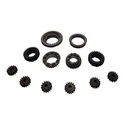
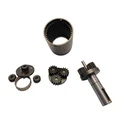
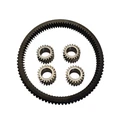
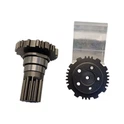
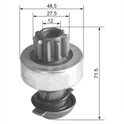
At Wuxi Superhuman Gear Cold Extrusion Co., Ltd., we've supplied Bendix drive components to starter manufacturers across passenger, commercial, and off-highway segments. And the question we hear most often isn't "What's a Bendix drive?" but "How do I make sure the replacement actually fits my vehicle-and won't fail in six months?" The answer isn't found in a universal part number. It comes from matching design details to real-world application requirements.
Last spring, a fleet operator managing mixed-model delivery vans ordered what they believed was a "universal" Bendix replacement. The unit physically bolted in-but within weeks, two vehicles reported intermittent grinding during cold starts. After receiving the returned assemblies, we found the issue: the spline count matched, but the pinion helix angle was optimized for gasoline engines, not the higher-inertia diesel cranking profile these vans used. After switching to a diesel-spec Bendix with adjusted spring rates and cold-rated lubrication, engagement reliability returned to 99.8%. The lesson: compatibility isn't just about dimensions-it's about system behavior.
Key Compatibility Factors Beyond "Fits Model X"
From our cold extrusion and application support work at Superhuman Gear, five details consistently determine whether a Bendix drive works reliably in a specific vehicle:
1. Engine type and cranking profile: Gasoline, diesel, hybrid, and start-stop systems place different demands on engagement timing and torque transfer. A Bendix optimized for smooth gasoline cranking may chatter or slip under diesel compression loads.
2. Starter motor specifications: Voltage, power rating, rotation direction, and solenoid type all influence Bendix selection. One agricultural client learned this after a "compatible" replacement failed because the solenoid stroke didn't match the pinion travel distance.
3. Flywheel ring gear geometry: Tooth count, pressure angle, and material hardness must align with the pinion design. Mismatched profiles accelerate wear on both components-even if initial engagement seems fine.
4. Operating environment: Cold climates need low-temperature grease and spring materials; dusty or marine environments require enhanced sealing. We validate these in our thermal and contamination testing labs.
5. Vehicle duty cycle: Stop-start urban delivery, long-haul highway, or off-road cyclic loading each create unique wear patterns. Bendix components should be specified accordingly.
A Practical Compatibility Checklist
When evaluating Bendix drive fitment for a specific vehicle model, we recommend this workflow:
✅ Verify dimensional specs first:
- Spline count, diameter, and lead angle
- Pinion tooth count, module, and pressure angle
- Overall length, mounting bolt pattern, and solenoid linkage geometry
✅ Confirm performance requirements:
- Peak cranking torque and engagement speed
- Expected temperature range and duty cycle
- NVH (noise, vibration, harshness) targets
✅ Validate material and process suitability:
- Cold-extruded vs. cut gear teeth for durability
- Heat treatment and surface finish for wear resistance
- Lubrication type and sealing method for environmental protection
One commercial vehicle manufacturer reduced field compatibility issues by 60% after adopting this checklist-and sharing it with their service network.
How Precision Manufacturing Supports Reliable Fitment
At Wuxi Superhuman Gear, we've learned that compatibility starts long before installation. Cold-extruded pinion gears with consistent tooth profiles engage more smoothly and resist wear longer than cut alternatives. Similarly, precision-formed splines with controlled surface finish reduce friction and contamination buildup-critical for vehicles operating in challenging conditions.
For a recent hybrid-electric platform, we worked with the starter supplier to optimize Bendix spring rates and engagement timing for the unique cranking profile. The result: seamless integration with the vehicle's start-stop logic and zero engagement-related warranty claims in the first production year.
Our Approach at Superhuman Gear
We don't just supply parts-we help ensure they work in context. When a client shares a vehicle compatibility question, we:
- Cross-reference dimensional specs with application requirements
- Simulate engagement dynamics under target operating conditions
- Recommend material, geometry, or process adjustments for durability
- Provide validation data to support service and warranty decisions
The Bottom Line
Bendix drive compatibility isn't about finding a part that "fits." It's about matching mechanical design, material performance, and engagement behavior to a specific vehicle's operating reality. At Wuxi Superhuman Gear Cold Extrusion Co., Ltd., we engineer starter components based on measured performance data and field-proven reliability. Because in automotive service, the best replacement isn't the one that bolts in-it's the one that engages cleanly, starts reliably, and stays quiet mile after mile.