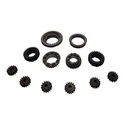
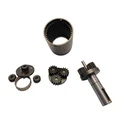
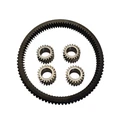
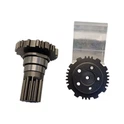
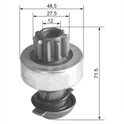
At Wuxi Superhuman Gear Cold Extrusion Co., Ltd., we've cold-formed pinion gears for Bendix drives across passenger cars, commercial trucks, and heavy equipment. And the question we hear most often isn't "What's a Bendix drive?" but "Why can't I just use the same drive for my diesel and gasoline starter projects?" The answer isn't marketing-it's physics, torque, and real-world engagement behavior.
Last winter, a client developing a dual-fuel generator set initially specified the same Bendix assembly for both their gasoline and diesel variants. Lab testing looked fine. But field trials told a different story: the diesel units showed intermittent grinding during cold cranking, while gasoline versions performed reliably. After sectioning returned components, we found the root cause: the diesel pinion teeth experienced 3x higher impact loads during engagement due to higher compression ratios. The gasoline-optimized drive simply wasn't built for diesel's mechanical demands. After switching to a diesel-spec Bendix with reinforced tooth roots and adjusted spring rates, cold-crank reliability matched the gasoline baseline. The fix wasn't about bigger parts-it was about matching design to duty.
Why Diesel Engines Demand More from Bendix Drives
From our cold extrusion and testing experience at Superhuman Gear, three factors consistently differentiate diesel and gasoline Bendix requirements:
1. Higher cranking torque: Diesel engines require significantly more torque to overcome compression-often 2–3x that of comparable gasoline engines. This means Bendix drives for diesel applications need stronger pinion gears, more robust overrunning clutches, and springs tuned for higher engagement forces.
2. Slower cranking speeds: Diesel starters typically spin slower but with greater force. This changes engagement dynamics: the pinion has less inertia to help it slide into mesh, making positive solenoid actuation more critical than inertia-based designs.
3. Harsher operating conditions: Diesel applications-commercial transport, construction, marine-often face wider temperature ranges, more vibration, and longer duty cycles. Bendix components must resist fatigue, contamination, and thermal cycling accordingly.
Design Differences You Can Actually Measure
When we engineer Bendix drives at Superhuman Gear, these specifications typically differ between diesel and gasoline applications:
| Parameter | Gasoline-Optimized | Diesel-Optimized |
| Pinion tooth root strength | Standard cold-extrusion | Reinforced grain flow + optimized die geometry |
| Overrunning clutch type | Roller-type (smooth engagement) | Sprag-type or heavy-duty roller (higher torque capacity) |
| Return spring rate | Balanced for quick retraction | Higher force to overcome spline friction under load |
| Lubrication spec | General-purpose grease | Wide-temperature synthetic with anti-wear additives |
| Engagement mechanism | Inertia or light solenoid-shift | Pre-engaged solenoid with positive mechanical actuation |
One heavy-equipment client reduced Bendix-related warranty claims by 45% after switching from a "universal" drive to a diesel-optimized assembly-not because the original was defective, but because it wasn't engineered for diesel's unique stress profile.
Compatibility Isn't Just About Bolt Patterns
A common misconception: if the spline count and mounting holes match, the Bendix will work. We've seen this assumption cause field failures. A gasoline-spec pinion may physically engage a diesel flywheel-but under repeated high-torque cranking, tooth chipping, clutch slippage, or spring fatigue can emerge within months.
At Superhuman Gear, we validate compatibility through application-specific testing: simulating diesel compression loads, cold-weather viscosity changes, and cyclic engagement patterns. One agricultural machinery manufacturer adopted this approach and saw starter service intervals extend by 30% simply by matching Bendix design to engine type.
Our Practical Approach at Wuxi Superhuman Gear
When a client asks about Bendix selection for diesel vs. gasoline applications, we don't start with part numbers. We help them:
- Analyze cranking torque, speed, and temperature requirements
- Specify pinion geometry and material treatment for the target duty cycle
- Validate engagement performance under simulated real-world conditions
- Provide dimensional and performance data to support service and warranty decisions
The Bottom Line
Bendix drives for diesel and gasoline engines aren't interchangeable-not because of marketing, but because of mechanical reality. Diesel applications demand stronger components, more positive engagement, and greater durability under stress. At Wuxi Superhuman Gear Cold Extrusion Co., Ltd., we engineer starter components based on measured performance data and field-proven reliability. Because in automotive and industrial systems, the best component isn't the one that fits-it's the one that engages cleanly, starts reliably, and stays quiet mile after mile, regardless of what's under the hood.