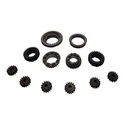
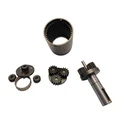
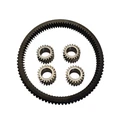
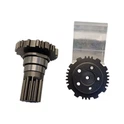
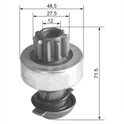
At Wuxi Superhuman Gear Cold Extrusion Co., Ltd., this is one of the most practical questions we get from customers-usually when they are sourcing replacements or dealing with compatibility issues: "We know we need a Bendix drive, but how do we make sure we choose the right one?"
In real projects, selecting the correct Bendix drive is not just about matching a part number. It's about ensuring the drive fits, engages correctly, and performs reliably under actual working conditions.
1. Start with basic compatibility: dimensions and fit
The first step is always mechanical compatibility.
Key parameters include:
Shaft diameter and spline type
Overall length of the drive assembly
Mounting interface with the starter motor
We've worked with customers who ordered parts based only on appearance, only to find slight dimensional differences that caused installation problems. Even small deviations can affect movement and engagement.
Practical tip:
Always confirm exact dimensions-not just model names.
2. Gear specifications: tooth count and module
The pinion gear must match the flywheel precisely.
Important factors:
Number of teeth
Gear module (pitch)
Tooth profile accuracy
If these don't match:
The gear may not engage properly
Noise and wear will increase
Long-term damage to the flywheel can occur
We once supported a customer who experienced repeated gear wear. The issue turned out to be a mismatch in tooth profile rather than material quality.
3. Overrunning clutch performance
The internal overrunning clutch is critical for both performance and protection.
What to check:
Smooth locking in one direction
Free rotation in the opposite direction
Durability under repeated cycles
In some lower-quality products, the clutch may fail early, causing:
Starter spinning without engine engagement
Increased wear on internal components
From our experience, this is one of the most important factors affecting reliability.
4. Engine type and application conditions
Not all Bendix drives operate under the same load.
Passenger vehicles → standard load conditions
Diesel engines → higher torque requirements
Heavy equipment → more demanding operating cycles
We've seen customers use standard components in high-load applications, which led to early failure. Matching the Bendix drive to the actual working environment is essential.
5. Material and manufacturing quality
At Wuxi Superhuman Gear Cold Extrusion Co., Ltd., we've found that long-term performance depends heavily on manufacturing quality.
Key aspects include:
Gear hardness and heat treatment
Surface finish of the spline and shaft
Dimensional consistency from batch to batch
We've analyzed failed parts where the issue was not design, but inconsistent production quality, leading to uneven wear and poor engagement.
6. OEM vs aftermarket considerations
Another common question is whether to choose OEM or aftermarket parts.
In practice:
OEM parts → designed for exact fit and original specifications
Aftermarket parts → may vary in quality depending on manufacturer
We often recommend focusing on specification and manufacturing capability, rather than just labeling. A well-made aftermarket component can perform as reliably as an OEM part if produced with proper standards.
7. Real-world selection approach
In actual sourcing projects, we usually guide customers through this process:
1. Confirm starter motor model or technical drawings
2. Verify gear specifications and dimensions
3. Evaluate application load and working conditions
4. Check clutch performance requirements
5. Validate with sample testing if possible
This reduces the risk of mismatch and ensures stable long-term operation.
Final thoughts from manufacturing experience
At Wuxi Superhuman Gear Cold Extrusion Co., Ltd., we've seen that choosing the right Bendix drive is not about finding a part that "fits," but one that fits and performs consistently over time.
The right selection depends on:
Accurate mechanical matching
Reliable clutch performance
Proper adaptation to application conditions
In real-world use, when these factors are aligned, the starting system operates smoothly and predictably. When they are not, even a small mismatch can lead to repeated failures.
That's why careful selection at the beginning often saves significant time and cost later.