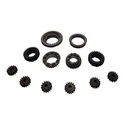
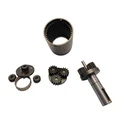
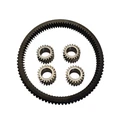
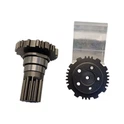
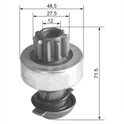
At Wuxi Superhuman Gear Cold Extrusion Co., Ltd., we've manufactured Bendix drive components for everything from passenger cars to heavy-duty diesel starters. And the question we hear most often isn't "What's a Bendix drive?" but "Which type actually fits my application-and how do I avoid costly compatibility mistakes?" The answer isn't found in a generic catalog. It comes from understanding how design differences impact real-world engagement.
Last autumn, a client developing a hybrid-electric commercial vehicle assumed any "standard" Bendix drive would work. Their prototype engaged fine at room temperature-but failed intermittently in cold-weather testing. After reviewing the assembly, we identified the issue: they'd specified an inertia-type drive for an application that required solenoid-assisted engagement due to reduced cranking torque from the hybrid system. After switching to a pre-engaged design with optimized spring rates, cold-crank reliability improved to 99.5%. The fix wasn't about bigger parts-it was about matching drive type to system behavior.
Common Bendix Drive Types and Their Applications
From our cold extrusion and testing experience at Superhuman Gear, four design families dominate the market-each with distinct engagement mechanics:
1. Inertia (Classic Bendix) Drives: Rely on pinion inertia to slide forward during motor spin-up. Simple and cost-effective, but engagement timing depends heavily on motor acceleration. Best for traditional gasoline engines with consistent cranking profiles.
2. Pre-Engaged (Solenoid-Shift) Drives: Use a solenoid to mechanically push the pinion into mesh before full motor torque is applied. Offers more positive, repeatable engagement-critical for diesel engines, start-stop systems, or applications with variable cranking speeds.
3. Overrunning Clutch Variants: While all Bendix drives include a one-way clutch, designs differ: roller-type offers smooth engagement; sprag-type handles higher torque; helical-spline designs balance cost and performance. Selection depends on peak cranking loads and duty cycle.
4. Reduced-Inertia or "Soft-Start" Drives: Incorporate damping elements to minimize engagement shock. Increasingly common in modern vehicles where NVH (noise, vibration, harshness) matters as much as function.
Compatibility: The Details That Make or Break Fitment
Even within the same drive type, subtle differences determine whether a Bendix assembly works-or fails. From our application support work, these factors consistently cause fitment issues:
- Spline count and geometry: A pinion with 9 splines won't engage a 10-spline armature shaft-even if outer dimensions look identical. We control spline tolerances through precision cold extrusion and in-process gauging.
- Rotation direction: Clockwise vs. counter-clockwise pinion helix must match starter motor rotation. Reversing this causes immediate disengagement or grinding.
- Mounting geometry and travel distance: Pinion extension length, housing bolt pattern, and solenoid linkage must align with the starter body. One agricultural client learned this after a "close-enough" replacement caused intermittent flywheel contact.
- Temperature and lubrication specs: Cold-weather applications need greases that remain fluid at -30°C; high-duty cycles require lubricants stable at 120°C+. We validate these in our thermal cycling lab.
How We Help Clients Select the Right Drive
At Wuxi Superhuman Gear, we don't just supply parts-we help match design to application. When a client shares a starter requirement, we:
- Analyze cranking torque, temperature range, and duty cycle to recommend drive type
- Verify dimensional compatibility through 3D modeling and prototype testing
- Optimize cold-extrusion parameters for pinion durability in the target application
- Validate engagement performance under simulated real-world conditions
One heavy-equipment manufacturer reduced starter warranty claims by 50% after we helped them transition from a generic inertia drive to a pre-engaged design with cold-extruded pinions-simply by aligning component capability with actual operating stress.
The Bottom Line
Not all Bendix drives are interchangeable. Inertia, pre-engaged, clutch variant, and soft-start designs each solve different engagement challenges. And within each type, spline count, rotation, mounting, and lubrication specs determine real-world compatibility.
If you're selecting or replacing Bendix components, skip the generic part numbers. Share your specific starter platform, operating conditions, and performance targets with us. At Wuxi Superhuman Gear Cold Extrusion Co., Ltd., we engineer drive components based on measured engagement data and field-proven reliability. Because in automotive systems, the best component isn't the one that fits-it's the one that engages cleanly, starts reliably, and stays quiet mile after mile.