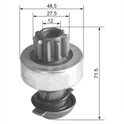
At Wuxi Superhuman Gear Cold Extrusion Co., Ltd., most conversations about Bendix drives don't start from theory-they start from a complaint: "The starter spins, but the engine doesn't crank," or "There's a grinding noise when starting."
Before replacing the entire starter motor, it's worth taking a closer look. In many cases, the issue is isolated to the Bendix drive (starter drive assembly). Below is how we typically help customers diagnose it in real working conditions.
1. Start with the symptoms: what is the starter actually doing?
Different symptoms usually point to different problems inside the Bendix drive.
a) Starter spins freely, engine doesn't turn
This is one of the most common signs.
Likely cause: the pinion gear is not engaging the flywheel, or the overrunning clutch is slipping.
b) Grinding or harsh noise during startup
Likely cause: improper gear engagement, worn gear teeth, or misalignment.
c) Intermittent starting (sometimes works, sometimes not)
Likely cause: inconsistent movement of the Bendix drive along the shaft, often due to wear or contamination.
We've seen many cases where these symptoms were initially blamed on electrical issues, but the root cause turned out to be purely mechanical.
2. Visual inspection: simple but often overlooked
Once the starter is removed, a basic inspection can reveal a lot.
Check for:
- Worn or damaged gear teeth
- Uneven wear patterns
- Contamination (dust, oil, metal debris)
- Surface roughness on the shaft or spline
One customer we worked with found that fine metal debris had accumulated on the shaft, preventing smooth movement of the drive. Cleaning and slight reconditioning solved the issue without replacing the whole unit.
3. Check the movement of the Bendix drive
The Bendix drive should move smoothly along the shaft.
Test manually:
- Push the pinion gear forward
- Check if it slides freely and returns properly
If it feels:
- Stiff or stuck → possible contamination or deformation
- Too loose or inconsistent → possible wear or internal damage
In real use, even slight resistance can delay engagement and cause starting problems.
4. Test the overrunning clutch function
This is a critical step that many people miss.
Hold the gear and rotate:
- It should lock in one direction
- It should rotate freely in the opposite direction
If the gear:
Spins freely in both directions → clutch failure
Locks in both directions → clutch jam or internal damage
We've seen multiple cases where customers replaced the entire starter, only to find later that the issue was just a worn clutch inside the Bendix drive.
5. Check engagement marks with the flywheel
Sometimes the issue is not obvious until you look at how the gear interacts with the flywheel.
Look for:
- Uneven contact marks
- Partial engagement patterns
- Signs of repeated slipping
These are often indicators of:
Misalignment
- Gear precision issues
- Incomplete engagement during operation
6. Consider operating conditions
From our experience at Wuxi Superhuman Gear Cold Extrusion Co., Ltd., real-world conditions matter a lot.
Factors that accelerate failure include:
- Frequent start-stop cycles
- Dust or harsh environments
- Poor lubrication
- Low-quality materials or machining
We've worked with heavy equipment customers where Bendix drives failed faster simply due to tougher working conditions, even though the design itself was standard.
7. When should you replace instead of repair?
In practice:
Minor contamination or movement issues → may be fixable
Gear wear or clutch failure → usually requires replacement
Because the Bendix drive is a precision mechanical assembly, repairing internal components is not always cost-effective or reliable in the long term.
Final thoughts from real diagnostic experience
At Wuxi Superhuman Gear Cold Extrusion Co., Ltd., we've seen that diagnosing a faulty Bendix drive is less about complex tools and more about understanding how the component is supposed to behave.
A properly functioning Bendix drive should:
- Move smoothly
- Engage quickly
- Transfer torque reliably
- Disengage without resistance
When any of these actions are inconsistent, the issue often becomes visible through careful observation.
In real maintenance scenarios, taking the time to diagnose the Bendix drive correctly can prevent unnecessary replacements and help identify the true source of starting problems more efficiently.