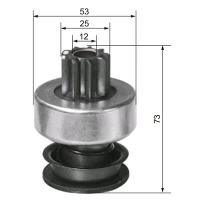
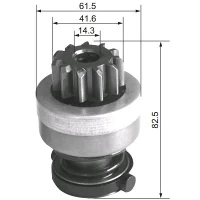
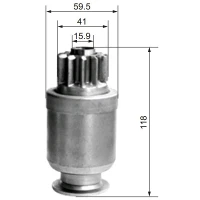
At Wuxi Superhuman Gear Cold Extrusion Co., Ltd., we've listened to countless starter noise complaints over the years. And the question we hear most often isn't "Is my starter broken?" but "Is that grinding sound coming from the Bendix drive or the flywheel-and how do I know which to fix?" The answer isn't found in guesswork. It comes from understanding how engagement mechanics actually work-and what real wear patterns look like.
Last autumn, a client operating a fleet of delivery trucks reported increasing grinding noises during cold starts. Initial diagnostics pointed to the starter motor, but after receiving returned units and inspecting the flywheels, we found a more nuanced picture: the pinion gears showed slight tip wear from repeated marginal engagement, while the flywheel ring gears had developed localized hardening at the contact zone. The noise wasn't one component failing-it was the interaction between two worn surfaces under low-temperature conditions.
How to Tell: Bendix Drive vs. Flywheel
Grinding during cranking usually means metal-to-metal contact where there should be smooth meshing. But pinpointing the source requires looking at timing, sound character, and physical evidence:
- If the grinding happens only during initial engagement (first 1–2 seconds of cranking), the Bendix drive is the likely culprit. Worn helical splines, a weak return spring, or a sluggish solenoid can cause the pinion to "chatter" against the flywheel before fully seating.
- If the grinding persists throughout cranking, the issue is more likely misalignment, worn pinion teeth, or damage to the flywheel ring gear. One heavy-duty application client traced persistent grinding to a slightly bent starter mounting bracket-causing the pinion to engage at an angle.
- If the noise is intermittent or temperature-dependent, consider lubrication viscosity, spring performance, or thermal expansion effects. We've seen cold-weather grinding resolve simply by switching to a lower-temperature grease in the Bendix assembly.
What We See in Returned Components
From our cold extrusion and failure analysis work at Superhuman Gear, three physical clues help distinguish the root cause:
1. Pinion gear wear pattern: Uniform tip wear suggests repeated marginal engagement (Bendix travel issue). Localized chipping or spalling often points to flywheel tooth damage or misalignment.
2. Flywheel ring gear condition: If only one sector of the ring gear shows wear, the starter may be misaligned. If wear is evenly distributed but teeth are hooked or rounded, the pinion geometry or engagement force may be off.
3. Spline and clutch condition: Burrs on helical splines or brinelling on clutch rollers indicate binding or overload-often a Bendix-side issue that indirectly damages the flywheel over time.
Prevention Through Precision Manufacturing
At Wuxi Superhuman Gear, we've learned that many grinding issues start long before installation. Subtle variations in cold-extruded pinion geometry, tooth profile accuracy, or surface finish can accelerate wear during real-world engagement cycles.
For example, a pinion with slightly inconsistent lead angle may engage noisily, increasing impact loads on both itself and the flywheel. Or a clutch cage with marginal dimensional control may allow rollers to skew under load, causing uneven torque transfer. We control these variables through in-process monitoring and application-specific validation-not just final inspection.
Our Practical Approach at Superhuman Gear
When a client shares a starter noise concern, we don't start with assumptions. We request field-return samples when possible, then:
- Section Bendix assemblies and flywheel segments to map wear patterns
- Measure critical dimensions (tooth profile, spline clearance, clutch geometry) against original specs
- Simulate engagement cycles under controlled loads and temperatures to reproduce the noise
- Recommend material, geometry, or process adjustments to improve engagement smoothness
One commercial vehicle client reduced starter-related warranty claims by 45% after we optimized the pinion gear's cold-extrusion parameters to improve tooth root strength and surface consistency.
The Bottom Line
A grinding starter isn't just annoying-it's a warning sign. Whether the root cause lies in the Bendix drive or the flywheel, the noise indicates that engagement isn't happening cleanly. At Wuxi Superhuman Gear Cold Extrusion Co., Ltd., we engineer starter components based on measured performance data and field-proven reliability. Because in automotive systems, the best parts aren't the quietest on the bench-they're the ones that engage smoothly, start reliably, and stay quiet mile after mile.