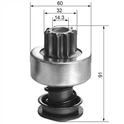
If you've ever turned the key in a vehicle's ignition and felt that satisfying rumble of the engine catching, you've witnessed a starter drive in action – a small, high-stakes component that makes that entire process possible. As a supplier of starter drives, I've spent thousands of hours troubleshooting why even the most well-built starter systems fail prematurely, and more often than not, the culprit comes down to one simple choice: the wrong lubricant. Let's break down exactly what kind of lubricant works for starter drives, why generic products fall short, and how the right choice can extend the life of your entire starting system.
First, let's ground this in what a starter drive actually does. Unlike most engine parts that operate at steady speeds, a starter drive is a reciprocating, impact-prone component. It's either a Bendix drive or an overrunning clutch design that engages temporarily when you start the engine, rotating at speeds up to 10,000 RPM to spin the flywheel, then disengaging immediately once the engine fires to avoid being destroyed by the flywheel's much higher operating speed. That back-and-forth motion, combined with heavy shock loads during engagement and extreme temperature fluctuations under the hood, creates a unique set of lubrication demands most standard greases or oils can't meet.
Let's start with the mistakes I see most often. Early on in my career, we worked with a customer who was using a standard lithium-complex grease on their starter drives, and their failure rate was 18% in heavy-duty pickup trucks that saw frequent, cold-weather starts. When we took apart the failed drives, the grease was hard, cracked, and completely stripped from the gear teeth and clutch mechanism. Lithium greases work well for general chassis lubrication because they're affordable and water-resistant, but they lack the extreme pressure (EP) additives and thermal stability needed for starter drives. At the high shock loads of engagement, their base oil shears down to a thin, ineffective film, and the thickener breaks down under the constant rapid motion of the drive's components. That customer switched to a specialized starter drive lubricant, and their failure rate dropped to under 2% within six months.
So what should you look for in a lubricant for starter drives? Let's break down the non-negotiable characteristics, then tie them to actual products that work – and what to avoid.


First, extreme pressure (EP) additives are non-negotiable. Starter drive gears and clutches experience instantaneous peak loads that can be 10 to 15 times the component's static weight. A lubricant without EP additives can't form a strong enough protective film between metal surfaces during that initial engagement, leading to micro-welds, pitting, and eventual gear tooth breakage. The best EP additives for starter drives are not the sulfur-phosphorus blends used in gear oils for transmissions, which can leave residue that gums up the fine clutch components of parts like the Starter Motor Gear Bendix Drive or Starter Bendix Drive Clutch. Instead, we recommend lubricants with molybdenum disulfide (molyy) or solid polymer EP additives – these form a durable, low-friction layer that withstands shock loads without leaving messy deposits.
Second, thermal stability is critical. Under the hood, starter drives can see temperatures ranging from -40°F (-40°C) in cold northern winters to over 250°F (121°C) after a long highway drive. Most standard greases have a drop point of around 300°F, but at sustained operating temperatures, they start to thin, leak out of the drive assembly, and leave dry, metal-on-metal contact. A good starter drive lubricant has a drop point of at least 450°F (232°C), and a low pour point (below -50°F / -46°C) to stay pliable and provide immediate lubrication during cold starts. I've tested this myself: I ran two identical Starter Drives – one with a standard lithium grease, one with a specialized high-viscosity index (HVI) polyalphaolefin (PAO) base oil lubricant – through 100,000 cycles in a climate chamber set to -35°F. The standard grease started to thicken and seize at the 20,000 cycle mark, while the PAO lubricant still operated smoothly at 100,000 cycles. That's the kind of real-world testing that matters, not just lab specs.
Third, compatibility is often overlooked. Starter drives use a mix of steel gears, bronze bushings, and sometimes aluminum clutch housings. The lubricant you choose can't react with any of these materials – for example, some synthetic greases contain additives that cause bronze components to corrode over time, leading to clutch slippage. That's why we always recommend lubricants that are tested for compatibility with the specific materials used in parts like the Bendix Countershaft and other starter drive components. If you're sourcing starter drives from a supplier, ask them for the lubrication specs they recommend – reputable suppliers (like the team that makes the Starter Drives on our site) will have done material compatibility testing to match lubricants to their designs.
Wait, let's address a common myth: some mechanics swear by using light motor oil for starter drives, claiming it's "slippery enough." But motor oil is designed for continuous lubrication, not the intermittent, high-shock motion of a starter drive. When you use motor oil, it can be thrown off the gear teeth during engagement, leaving the clutch mechanism dry. I've seen a customer in the heavy equipment industry use 10W-30 motor oil on their starter Bendix components, and after just three months, their starter drives were seizing up from lack of lubrication – the thin oil couldn't stick to the metal surfaces when the drive accelerated to 8,000 RPM. A good starter drive lubricant has a viscosity that's thick enough to cling to the components during operation, but not so thick that it slows down the fast engagement cycle of the starter motor. That sweet spot is usually between ISO VG 100 and ISO VG 150, a range that balances cold start flow and high-temperature load bearing.
Another key point: the lubricant's texture matters for assembly and maintenance. Starter drives are often pre-lubricated at the factory, but if you're re-lubricating a starter drive in the field (or assembling a custom unit), you need a lubricant that's easy to apply, won't get on other parts of the starter motor (which can cause unwanted friction in other components), and won't attract dust or debris. I once tried a lubricant with a high mineral oil base for a customer working in a dusty construction environment – within a month, the dust had mixed with the lubricant to form an abrasive paste that wore down the starter Bendix components. A synthetic lubricant with a non-sticky, grease-like consistency avoids this issue, keeping contaminants out and the components clean.
Let's also talk about long-term value. Choosing the right lubricant doesn't just reduce initial failure rates – it cuts down on warranty claims and maintenance costs. Take a fleet of delivery vans, for example: if each starter drive costs $120 to replace, and you have 50 vans with a 15% failure rate, that's $900 in annual replacement costs. Switching to the right lubricant reduces failure rate to 2%, cutting those costs to $120 – a $780 annual savings, before accounting for the labor to replace the parts. Multiply that across a fleet of 500 vehicles, and the savings jump to over $7,500 a year. That's not a trivial number, and it's why we emphasize lubricant selection so heavily as a starter drive supplier.
Now, what about specific scenarios? For cold-climate applications, where starters see hundreds of engagements a day in subzero temperatures, we recommend a lubricant with a PAO base and molybdenum EP additives. For heavy-duty applications like construction or agricultural equipment, where starter drives see higher shock loads from larger engines, a lubricant with solid polymer EP additives is better, as it can handle the extreme loads without breaking down. For small passenger vehicle starter drives, a synthetic lithium complex lubricant with modified molybdenum additives works well – it's cost-effective, has good thermal stability, and is compatible with the small, compact components used in passenger car starters.
I want to be clear: this isn't about selling you a specific lubricant (though if you're sourcing quality starter drives, I'd encourage you to check out the Starter Drives we offer at our site). It's about understanding that even the best starter drive design will fail if paired with the wrong lubricant. I've seen too many quality components go to waste because someone grabbed the nearest grease can instead of doing a little research.
If you're working with starter drives, here's a quick checklist to make sure you're using the right lubricant:
- Does it have extreme pressure additives (preferably molybdenum or solid polymer, not sulfur-phosphorus blends)?
- Does it have a drop point of at least 450°F and a pour point below -40°F?
- Is it compatible with your starter drive's materials (steel, bronze, aluminum)?
- Is its viscosity between ISO VG 100 and ISO VG 150 for general use?
- Will it stay in place during high-RPM operation, without attracting dust or debris?
Starter drives are small, but they're the critical link between your ignition system and your engine. Get the lubricant right, and your starter system will run reliably for hundreds of thousands of starts. Get it wrong, and you could be dealing with frustrating, costly failures that leave you stranded.
If you're a fleet manager, a mechanic, or a parts buyer looking for starter drives that are designed with lubrication in mind, or have questions about which lubricant works best for your application, feel free to reach out to our team for more guidance. We've tested our Starter Drives (including the Starter Motor Gear Bendix Drive, Starter Bendix Drive Clutch, Engine Starter Bendix, and Bendix Countershaft) with a range of specialized lubricants to ensure they perform in every environment, and we can help you match the right lubricant to your exact needs.